
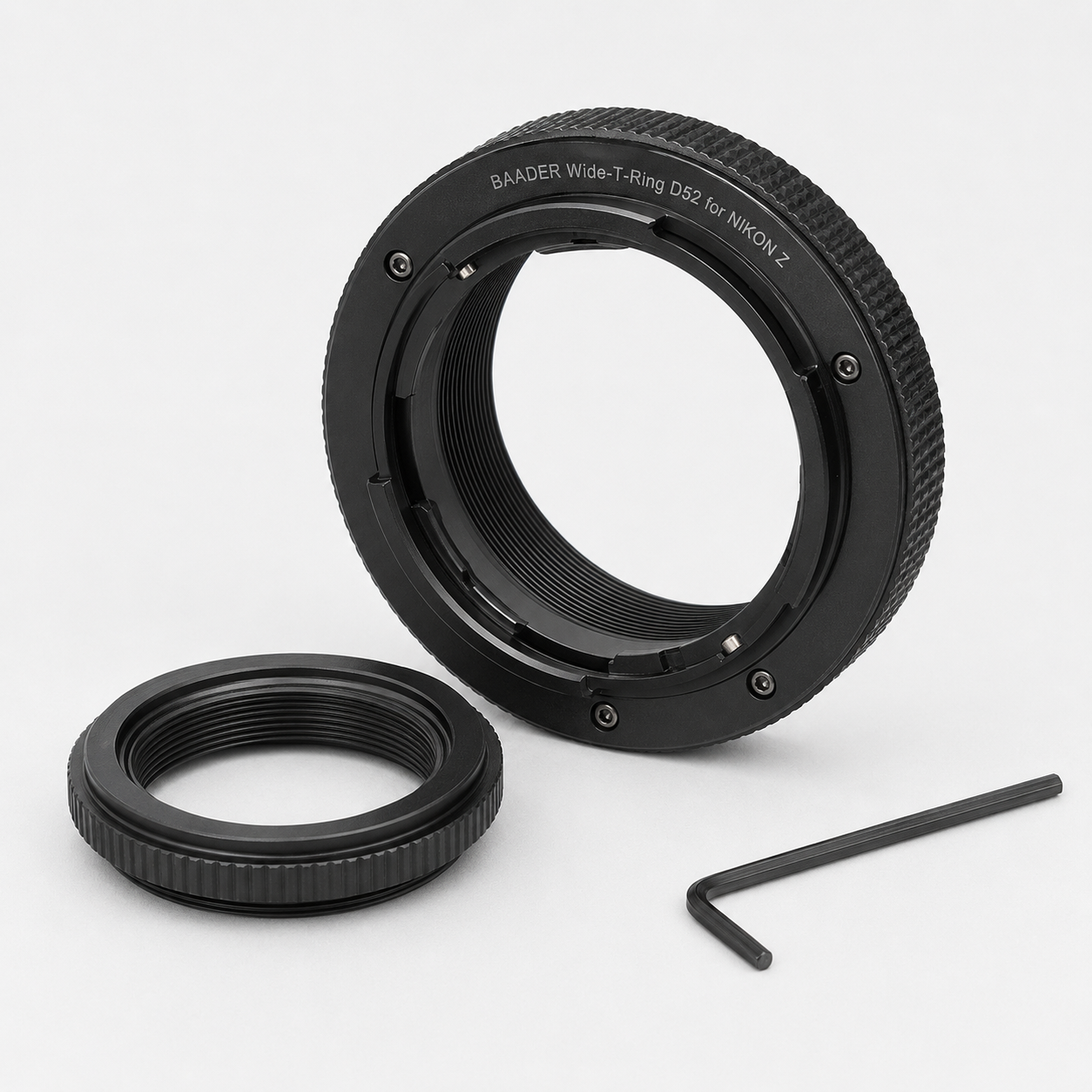
The baader wide t-ring set for nikon z camera is designed for photographers who want to connect a Nikon Z mirrorless body securely to a telescope, astrophotography accessory, or Baader’s modular Astro T-2 system.
What makes it more interesting than a basic T-ring is flexibility. Instead of locking you into a single narrow T-2 connection, Baader combines a Nikon Z bayonet fitting with a removable T-2 insert and a larger S52 interface, giving astrophotographers more options when building a wide-aperture imaging train.
This guide explains how the adapter works, what is included, where its wider design matters, what additional adapters you may need, and the mistakes to avoid before attaching an expensive Nikon Z camera to a telescope.
Baader Wide T-Ring Set for Nikon Z Camera Quick Facts
| Feature | Specification |
|---|---|
| Manufacturer | Baader Planetarium |
| Product type | Camera/T-ring adapter |
| Camera connection | Nikon Z bayonet |
| Telescope-side connection | M42 × 0.75 T-2 and S52 |
| T-2 clear aperture | Approx. 41 mm |
| Maximum clear aperture | Approx. 49.3 mm |
| Optical length | Approx. 8.3 mm |
| Outer diameter | Approx. 66.5 mm |
| Weight | Approx. 0.05 kg |
| Baader SKU | 2408335 |
| Main use | Telescope and astrophotography accessory connection |
These specifications are published by Baader for its Nikon Z Wide-T-Ring.
What Is the Baader Wide T-Ring for Nikon Z?
A T-ring provides the mechanical bridge between an interchangeable-lens camera body and telescope-side equipment.
On the camera side, the Baader model locks into a Nikon Z bayonet in place of a normal NIKKOR lens. On the telescope side, its included internal ring provides the familiar M42 × 0.75 T-2 female thread.
The important difference is what sits behind that T-2 insert.
Baader’s outer Wide-T-Ring incorporates an S52 interface. The T-2 insert can therefore be removed when you want to build an imaging train with a larger opening instead of forcing light through the smaller T-2 passage.
That modular construction is the main reason to choose it over a cheap conventional Nikon Z T-ring.
Why the “Wide” T-Ring Design Matters
The Nikon Z mount was developed with a large 55 mm inner diameter and a short 16 mm flange focal distance. Nikon specifically highlights those dimensions as important characteristics of the Z system.
Using a narrow adapter directly behind such a large camera mount can unnecessarily restrict the optical path.
Baader addresses this by giving the Wide-T-Ring a maximum clear aperture of approximately 49.3 mm when the T-2 restriction is removed. With the included T-2 insert installed, the clear aperture is approximately 41 mm.
Why Aperture Size Can Affect Astrophotography
Imagine the telescope producing a wide cone of light toward your sensor.
If an adapter in the middle of the imaging train has an opening significantly smaller than the light cone, it can become a mechanical bottleneck. Depending on the telescope, reducer, sensor size, spacing and other components, this restriction can contribute to darker corners.
A wider connection does not automatically eliminate all vignetting. The telescope itself, filters, reducers, flatteners and other adapters can still limit illumination.
The advantage is that the Wide-T-Ring gives you the option to avoid making the camera adapter an unnecessarily restrictive point.
What Comes With the Baader Wide T-Ring Set?
Retail listings for the Baader Nikon Z Wide T-Ring describe a two-part system consisting of the Nikon Z-specific bayonet ring and the removable S52-to-T-2 inner adapter. Some packages also list an Allen key.
The core components are therefore:
- Nikon Z bayonet Wide-T-Ring
- Removable S52/T-2 internal adapter
- T-2 female connection for conventional equipment
Packaging can vary by distributor or market, so check the retailer’s current “included items” section before ordering.
T-2, S52, M48 and M68 Explained
The terminology can look complicated if this is your first modular astrophotography setup.
Understanding the interfaces before buying additional components will save both money and frustration.
T-2: The Standard Starting Point
The supplied insert provides an M42 × 0.75 T-2 female thread.
This allows the ring to work with a huge range of astronomy equipment that terminates in a male T-2 connection.
For many basic telescope-camera setups, this is all you need on the camera side.
S52: The Modular Wide Connection
Remove the internal T-2 insert and you gain access to Baader’s S52 interface.
That larger interface is what transforms the product from a conventional T-ring into a modular Wide-T-Ring.
It can be adapted to different connection systems without replacing the Nikon Z bayonet ring itself.
M48: Useful for Wider Imaging Trains
Baader offers an S52-to-M48 adapter that converts the Wide-T-Ring to an M48 female connection. The company identifies adapter #2958552 for this purpose.
M48 connections are commonly chosen when a user wants a wider optical path than standard T-2.
This can be particularly relevant when using larger sensors or telescope accessories designed around 2-inch-class optical systems.
M68: For Even Wider Threaded Connections
Baader also identifies its S52/M68 adapter #2458252 as a way of attaching the Wide-T-Ring to an M68 male thread.
This is more likely to matter in advanced imaging systems where keeping the optical path wide is a priority.
UFC: Connecting a Filter Changer
The Wide-T-Ring can also be adapted to Baader’s Universal Filter Changer system using the company’s optional S52 UFC camera adapter. Baader lists part #2459119 for this configuration.
That makes the ring especially attractive if you expect your astrophotography setup to become more sophisticated over time.
Baader Wide T-Ring vs Standard Nikon Z T-Ring
| Feature | Standard T-Ring | Baader Wide T-Ring |
| Nikon Z bayonet | Yes | Yes |
| Basic T-2 connection | Usually | Yes |
| Removable T-2 insert | Usually no | Yes |
| Wider S52 interface | No | Yes |
| M48 upgrade potential | Depends on model | Yes, with adapter |
| M68 compatibility | Usually limited | Available with adapter |
| Baader UFC integration | Not normally | Supported |
| Best for | Simple setup | Modular astrophotography system |
A standard inexpensive T-ring may be perfectly adequate if your telescope permanently uses T-2 and you have no intention of changing the imaging train.
The Baader design becomes more compelling when flexibility, wider connections and future expansion matter.
Who Should Consider the Baader Wide T-Ring?
Full-Frame Nikon Z Astrophotographers
A wide mechanical opening is especially relevant when working with large sensors and an optical system capable of illuminating them.
The removable T-2 restriction lets you build toward a wider S52, M48 or M68 configuration rather than being permanently constrained by the supplied M42 connection.
Photographers Building a Modular Imaging Rig
Astrophotography systems rarely remain unchanged forever.
You may begin with:
Telescope → T-2 adapter → Nikon Z camera
Later you might want:
Telescope → reducer/flattener → filter system → spacer → Nikon Z camera
The Baader Wide-T-Ring is useful because the camera-side component can remain in place while the telescope-side interface evolves.
Users Planning to Add Filters
If filters are likely to become part of your setup, compatibility with Baader’s UFC system adds another expansion route.
This can be useful for astrophotographers who want to change filters without repeatedly dismantling their camera connection.
Owners of Simple T-2 Telescopes
You do not need a sophisticated system to benefit from it.
With the included T-2 insert installed, the adapter behaves like a conventional Nikon Z T-ring and connects to compatible male T-2 telescope accessories.
How to Connect a Nikon Z Camera to a Telescope
The exact components depend on your telescope.
A typical basic connection looks like this:
- Remove the lens from your Nikon Z camera.
- Align the Wide-T-Ring with the Nikon Z bayonet.
- Rotate it until it locks into position.
- Leave the supplied T-2 insert installed if your telescope adapter ends in a male T-2 thread.
- Thread the telescope-side adapter into the T-ring carefully.
- Attach the completed assembly to the telescope.
- Confirm that every connection is fully seated before releasing the camera.
- Check focus and optical spacing before beginning a long imaging session.
Never assume that the T-ring alone connects directly to every telescope.
Your telescope, reducer, field flattener or focuser may require another adapter between the telescope and the Baader ring.
Backfocus: The Detail Beginners Often Miss
One of the most important astrophotography concepts is backfocus, sometimes called working distance.
Many reducers and field flatteners are designed to place the camera sensor at a specific distance behind the optical accessory.
The Baader Wide-T-Ring itself has an optical length of approximately 8.3 mm.
That measurement matters when calculating the complete imaging train.
For example, your spacing calculation may need to include:
- Camera flange-to-sensor distance
- T-ring optical length
- Filter drawer thickness
- Extension rings
- Rotators
- Reducer or flattener requirements
Do not simply assemble parts until they physically connect.
A system can be mechanically secure yet optically spaced incorrectly.
A Critical Thread Mistake to Avoid
Do not confuse T-2 M42 × 0.75 with the old photographic M42 × 1.0 lens thread.
They share the same nominal 42 mm diameter but use different thread pitches.
The Nikon Z Baader Wide-T-Ring uses an M42 × 0.75 T-2 connection with its supplied insert.
Trying to force an M42 × 1 lens adapter into a T-2 thread can damage the threads.
If a component says only “M42,” confirm its pitch before purchasing or assembling it.
Does the Baader Wide T-Ring Reduce Vignetting?
Potentially—but this needs to be understood correctly.
Baader states that the wider clear aperture can improve illumination of the camera sensor compared with a more restrictive connection.
However, the adapter cannot fix vignetting caused elsewhere in the optical system.
Possible restrictions include:
- Telescope drawtube diameter
- Reducer or flattener
- Filter aperture
- Filter drawer
- Extension tubes
- Off-axis guider
- Narrow threaded adapters
- Telescope image circle
Think of the imaging train as a chain.
The widest T-ring in the world cannot compensate for another component that creates a substantially smaller opening upstream.
T-2 or Wide S52: Which Should You Use?
Keep the T-2 Insert When:
- Your existing telescope adapter is T-2.
- You use a smaller sensor.
- Your optical system already has a narrow light path.
- You want the simplest connection.
- Your current images show acceptable corner illumination.
Consider the Wider Configuration When:
- You use a full-frame Nikon Z body.
- Your telescope supports a large illuminated image circle.
- You are seeing mechanical vignetting.
- Your reducer or flattener has an M48 or larger connection.
- You want a Baader UFC filter setup.
- You are designing the imaging train from scratch.
The best configuration is not automatically the widest one.
The goal is to maintain an appropriately sized optical path without adding unnecessary adapters, length or mechanical complexity.
Pros and Cons
Pros
- Secure Nikon Z-specific bayonet connection
- Standard T-2 functionality included
- Removable T-2 insert
- Larger S52 interface underneath
- Can be converted toward M48 or M68 configurations
- Compatible with Baader UFC components
- Short 8.3 mm optical length
- Lightweight construction at roughly 50 g
- Suitable for simple and expandable imaging systems
Cons
- Wider configurations require optional adapters
- More expensive than many basic generic T-rings
- Beginners must understand thread standards
- Does not automatically solve backfocus problems
- Does not guarantee zero vignetting
- Telescope-specific adapters may still be required
Common Mistakes When Buying or Using the Adapter
1. Assuming “Nikon” Means Nikon F Mount
This model is designed for the Nikon Z bayonet, not the older Nikon F DSLR mount. Baader specifically lists Nikon Z as the camera connection.
Buy according to the mount on your camera, not simply the Nikon brand name.
2. Buying an M48 Adapter Without Checking Gender
Thread diameter alone is not enough.
Always check whether each side is:
- Male or female
- M42, M48 or M68
- Correct thread pitch
Draw the connection chain on paper before ordering.
3. Ignoring Backfocus
A reducer may physically connect while still producing poor stars toward the corners because the sensor spacing is incorrect.
Calculate the imaging train before buying random extension rings.
4. Expecting the T-Ring to Hold Filters
The Wide-T-Ring itself is primarily a camera adapter.
If you need removable astronomical filters, plan for a compatible filter drawer, filter wheel or Baader UFC configuration.
5. Adding Too Many Adapters
Every unnecessary adapter adds length and another mechanical junction.
Use the simplest connection that provides the required optical diameter and spacing.
How to Plan the Imaging Train Before Buying
A practical method is to work backward from the telescope.
Step 1: Identify the Telescope-Side Thread
Find the output connection on your:
- Telescope
- Reducer
- Field flattener
- Corrector
- Focuser
Write down its exact thread and gender.
Step 2: Check Required Backfocus
If an optical corrector specifies sensor spacing, note that number before selecting adapters.
Step 3: Decide Whether T-2 Is Wide Enough
If the equipment already ends in T-2 and your sensor is adequately illuminated, use the supplied insert.
If the optical system provides M48, M68 or another wide interface, consider preserving that diameter closer to the camera.
Step 4: Add Filters or Guiding Equipment
Decide whether you will include:
- Filter drawer
- Filter wheel
- Off-axis guider
- Camera rotator
- Tilt adjuster
Their optical thickness affects your spacing calculation.
Step 5: Finish at the Nikon Z Bayonet
The Baader Wide-T-Ring becomes the final mechanical interface before the camera.
This backwards-planning method is far more reliable than buying adapters individually and hoping they connect.
Is It Suitable for Nikon Z Full-Frame Cameras?
The adapter’s Nikon Z bayonet makes it mechanically relevant to Z-mount bodies, while the wider connection concept is particularly attractive for systems where a large sensor and wide telescope image circle make optical restrictions more noticeable.
That does not mean every full-frame Nikon Z telescope setup requires an S52 or M48 connection.
If the telescope itself only produces a modest image circle or uses T-2 throughout, replacing one section with a larger adapter may provide little practical improvement.
Evaluate the entire optical train rather than judging only the camera sensor.
Is It Useful for Nikon Z DX Cameras?
Yes, provided the camera uses the Nikon Z mount.
A DX sensor generally places less demand on edge illumination than a full-frame sensor because it uses a smaller portion of the telescope’s image circle.
In that situation, the included T-2 configuration may already be sufficient.
The modular design still gives you flexibility if you later change cameras or rebuild the telescope-side system.
Does It Replace the Nikon FTZ Adapter?
No—not for the normal purpose of mounting Nikon F-mount photographic lenses.
The Nikon FTZ is an F-to-Z lens mount adapter designed to let compatible F-mount NIKKOR lenses work with Nikon Z cameras. Nikon describes FTZ specifically as a mount adapter for using existing NIKKOR F-mount lenses with the Z system.
The Baader Wide-T-Ring serves a different purpose: connecting the Nikon Z camera body to astronomical T-2/S52-based equipment.
Do not buy it as a normal FTZ replacement.
Who Probably Does Not Need This Adapter?
The Baader solution may be unnecessary if you:
- Never expect to use anything wider than T-2
- Use a small-sensor camera with a basic telescope
- Need the cheapest possible one-purpose adapter
- Already own a secure Nikon Z T-ring that meets your needs
- Have a telescope-specific camera adapter that connects directly to Z mount
Its strongest selling point is not that it performs an impossible function.
Its advantage is that one camera-side ring supports multiple connection strategies.
Is the Baader Wide T-Ring Set Worth Buying?
For a simple beginner setup using only T-2, a generic T-ring can perform the essential task for less money.
The value of Baader’s design becomes clearer when you care about future expansion.
You can start with its included T-2 connection and later move toward S52, M48, M68 or Baader UFC components without replacing the Nikon Z camera-side bayonet ring.
That makes it particularly appealing for an astrophotographer who expects their equipment to evolve.
Frequently Asked Questions
What thread does the Baader Nikon Z Wide T-Ring use?
With its supplied insert, the telescope side provides an M42 × 0.75 T-2 female connection. The outer Wide-T-Ring also incorporates Baader’s S52 interface.
What is the clear aperture?
Baader lists approximately 41 mm through the T-2 configuration and approximately 49.3 mm for the wider opening.
How thick is the adapter?
Its published optical length is approximately 8.3 mm.
Can it connect to M48 equipment?
Yes, with the appropriate S52-to-M48 adapter. Baader identifies adapter #2958552 for converting the Wide-T-Ring toward an M48 female connection.
Can it connect to M68 equipment?
Baader offers an S52/M68 adapter, product #2458252, for connecting the Wide-T-Ring to compatible M68 equipment.
Can I use it with a filter drawer?
It can be incorporated into filter-based imaging trains. Baader specifically supports connection to its UFC filter changer through an optional S52 camera adapter.
Does it directly attach to every telescope?
No. The Nikon Z side is standardized, but the telescope side depends on the equipment you own.
You may need a telescope-specific T-2, M48, M68, 2-inch or other adapter.
Is it only useful for full-frame Nikon Z cameras?
No.
The adapter can also be useful with Nikon Z DX bodies, although the wider optical path is generally more compelling when a larger sensor and wide illuminated field make mechanical restrictions important.
Final Verdict
The baader wide t-ring set for nikon z camera is more than a basic piece of metal for attaching a camera to a telescope.
Its strongest feature is the removable T-2 insert combined with Baader’s larger S52 interface. That architecture lets beginners start with a familiar M42 × 0.75 T-2 connection while giving more advanced users a route toward M48, M68 and UFC-based imaging systems.
For someone building a permanent, expandable Nikon Z astrophotography setup, that flexibility can justify choosing the Baader Wide-T-Ring over a basic fixed T-ring.
The key is to buy it as part of a planned optical train. Check your telescope-side thread, required backfocus, filter hardware and sensor size first. When those pieces are matched correctly, the Baader Wide T-Ring provides a compact and adaptable camera-side foundation for Nikon Z astrophotography.
