
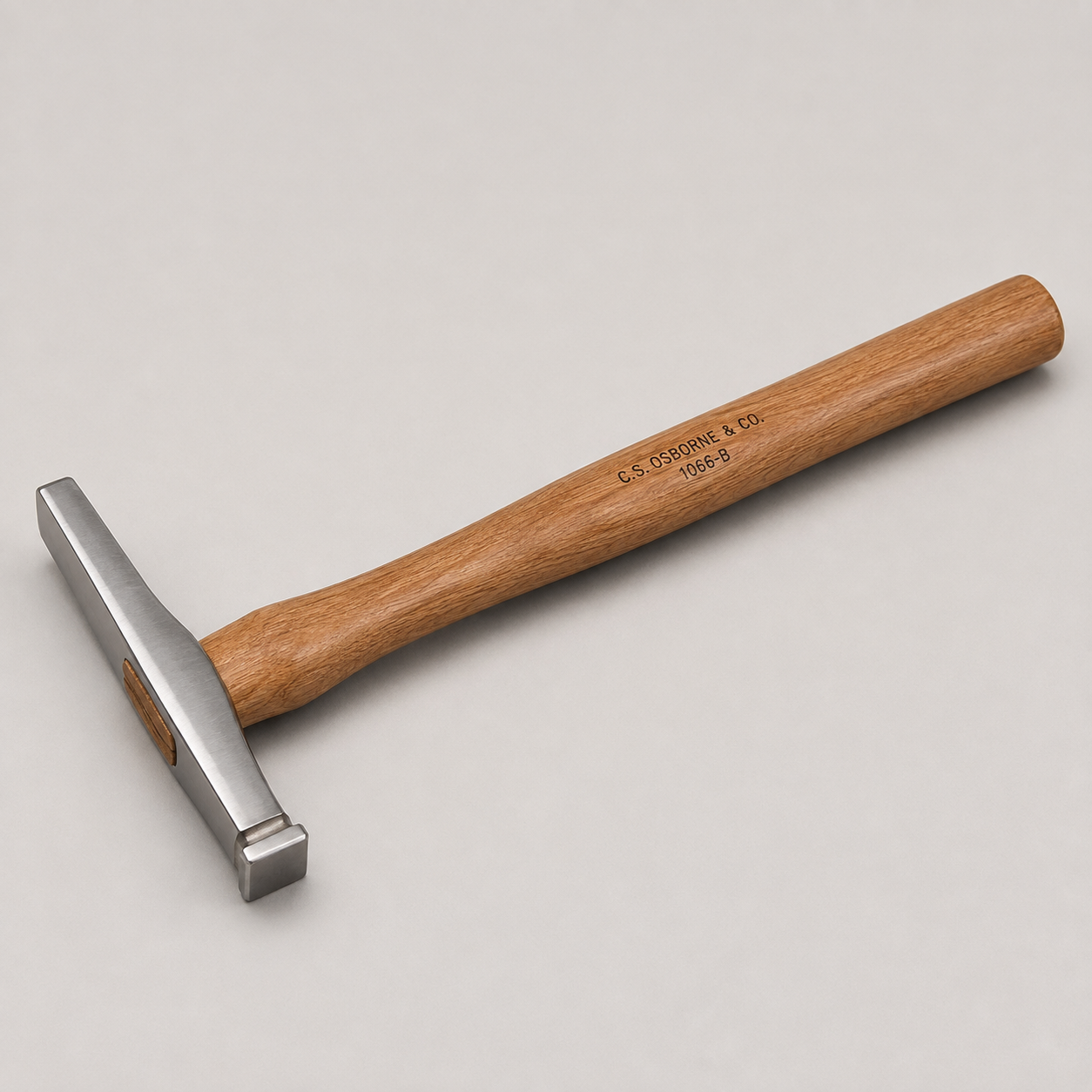
The c.s. osborne glazier hammer 1066b is a specialized hand tool made for craftspeople who need more control than a conventional household hammer provides. Sold by C.S. Osborne as the No. 1066 B Glazier & Picture Framing Hammer, it combines a compact forged-steel head, a narrow striking face, and a traditional hardwood handle in a lightweight 12-inch design.
For glaziers, picture framers, repair professionals, and detail-oriented craftspeople, those proportions matter. Instead of maximizing striking force, the 1066B is designed around controlled, accurate blows in work where surrounding glass, frames, trim, or finished surfaces may leave little room for error.
This guide examines its specifications, practical applications, advantages, limitations, proper use, maintenance, and what to check before buying.
Quick Facts: C.S. Osborne Glazier Hammer 1066B
| Specification | C.S. Osborne 1066B |
|---|---|
| Product type | Glazier & picture framing hammer |
| Model | No. 1066 B |
| Head material | Forged steel |
| Head finish | Fully polished |
| Handle | Hardwood |
| Head length | 4-1/4 inches |
| Face diameter | 11/16 inch |
| Overall length | 12 inches |
| Weight | 6 oz |
| SKU/UPC listed | 70042 |
| Manufacturer | C.S. Osborne & Co. |
These dimensions and construction details are listed by C.S. Osborne on its official product pages.
What Is the C.S. Osborne Glazier Hammer 1066B?
The C.S. Osborne 1066B is a purpose-built striking tool intended primarily for glazing and picture-frame work. The manufacturer describes it as an industry-standard hammer with a forged-steel, fully polished head, accurately finished straight sides, and a square striking face.
Those features distinguish it from a general-purpose claw hammer.
A household hammer is normally designed to deliver considerably more striking force and often includes a nail-pulling claw. A glazier hammer emphasizes compact dimensions, accuracy, access, and controlled striking instead.
That difference becomes particularly important when working close to:
- Glass panes
- Picture frames
- Moulding
- Small fasteners
- Finished wood
- Delicate trim
- Narrow frame channels
The goal is not simply to hit something harder. It is to place the strike precisely.
C.S. Osborne 1066B Specifications Explained
Specifications are more useful when you understand how they affect the tool in actual work.
4-1/4-Inch Forged-Steel Head
C.S. Osborne specifies a head length of 4-1/4 inches. The head is made from forged steel and is fully polished.
Forging is particularly appropriate for striking tools because the head must tolerate repeated impact. The relatively narrow overall profile also helps the user work in areas where a bulkier hammer head may feel cumbersome.
11/16-Inch Striking Face
The face diameter measures 11/16 inch.
This is one of the most important characteristics of the tool.
A smaller face gives the user a clearly defined contact area. When tapping small fasteners or working close to the edge of a frame, that precision can be more useful than the broad striking surface of a conventional hammer.
The tradeoff is equally important: a small face rewards accurate hammer technique. It is not designed to compensate for careless or poorly aimed blows.
12-Inch Overall Length
The official specification lists the hammer at 12 inches overall.
That length provides useful reach while keeping the tool compact enough for controlled bench work.
For framing and glazing tasks, a hammer does not necessarily become better simply because its handle is longer. Excessive leverage can work against the controlled striking these jobs often require.
6-Ounce Weight
The 1066B weighs 6 ounces, according to C.S. Osborne.
That lightweight construction is central to the character of the hammer.
A heavier framing or construction hammer develops far more momentum. The Osborne instead favors repeated, measured taps and easier handling during precision-oriented work.
Hardwood Handle
The 1066B uses a traditional hardwood handle rather than a molded synthetic grip.
Wood remains useful for hand striking tools because it provides a familiar shape, reasonable shock absorption, and straightforward handling.
Users accustomed to heavily cushioned modern handles may find the 1066B more traditional in feel, which is worth considering before purchase.
What Is the C.S. Osborne 1066B Used For?
Its official name provides the clearest answer: C.S. Osborne markets No. 1066B as a Glazier & Picture Framing Hammer.
That makes it particularly relevant for several forms of precision work.
Glazing Work
Traditional glazing can involve working extremely close to glass.
That changes the requirements of the hammer dramatically. Excessive striking force, a large hammer head, or poor control can increase the likelihood of damaging adjacent material.
A compact 6-ounce hammer with a narrow face gives experienced users greater control over the intensity and location of each strike.
Picture Framing
Picture framing frequently involves small hardware, moulding, backing components, and finished wood surfaces.
The 1066B is specifically marketed for picture framing as well as glazing, making it more directly suited to this environment than a large carpenter’s hammer.
Fine Bench and Workshop Tasks
The 1066B can also make sense for certain controlled workshop jobs where a narrow striking face and light head are preferable.
However, buyers should avoid interpreting “versatile” to mean universal.
This is fundamentally a specialized precision hammer. If the task requires driving large nails, demolition, framing lumber, or heavy structural assembly, a different hammer category will usually be more appropriate.
Why the 1066B Is Different From a Regular Hammer
At first glance, paying for a specialized hammer when you already own a claw hammer may seem unnecessary.
The difference becomes clearer when comparing the design priorities.
| Feature | C.S. Osborne 1066B | Typical General-Purpose Hammer |
| Primary purpose | Glazing/picture framing | General fastening |
| Weight | 6 oz | Usually substantially heavier |
| Face | Narrow 11/16-inch face | Broader striking face |
| Head | Compact forged steel | Larger general-purpose head |
| Handle | 12-inch hardwood | Varies |
| Nail-pulling claw | Not the focus | Common |
| Precision work | Strong fit | Depends on design |
| Heavy construction | Poor fit | Better fit |
The 1066B solves a different problem.
It is designed for users who value control and access more than maximum striking energy.
Major Advantages of the C.S. Osborne 1066B
Excellent Control
At only 6 ounces, the hammer allows the user to moderate impact more easily than with a significantly heavier construction hammer.
That is valuable when a powerful strike could cause damage.
Narrow Striking Face
The 11/16-inch face provides a compact contact area for accurate striking.
For detail work, this is one of the strongest reasons to choose a purpose-built glazier hammer rather than simply using whatever hammer happens to be nearby.
Forged-Steel Construction
C.S. Osborne uses a forged-steel head with a fully polished finish.
The result is a traditional professional hand-tool design rather than a disposable light-duty hammer.
Straight, Accurately Finished Sides
C.S. Osborne specifically highlights the accurately finished straight sides and square face of the 1066B.
This matters because the geometry of a specialized striking tool influences how predictably it can be positioned and used in confined work.
Useful 12-Inch Format
The 12-inch overall length gives the tool enough handle for comfortable use without turning it into an oversized hammer.
Established Tool Manufacturer
C.S. Osborne traces its manufacturing history to 1826 and specializes in professional hand tools for industries including upholstery, leatherworking, canvas work, and industrial applications. The company states that its tools are made in the United States.
That heritage is relevant for buyers who prefer established manufacturers of specialist trades tools.
Potential Drawbacks to Consider
No tool is ideal for every buyer.
It Is Highly Specialized
The biggest advantage of the 1066B is also its main limitation.
A 6-ounce glazier hammer should not be expected to replace a full-size carpenter’s, framing, or general-purpose hammer.
If you rarely work with picture frames or glazing materials, you may get less value from owning such a specialized tool.
The Small Face Requires Accuracy
A narrow striking face helps with precision, but it also provides less margin for a poorly aimed swing.
Good results still depend on technique.
Traditional Handle Design
Some users prefer rubberized, fiberglass, or highly contoured ergonomic handles.
The 1066B instead uses a traditional hardwood handle.
Whether that is an advantage or disadvantage depends largely on your working preferences.
No General-Purpose Claw
Buy this tool for controlled striking—not as a replacement for a claw hammer used for pulling conventional nails.
Pros and Cons at a Glance
Pros
- Purpose-built for glazing and picture framing
- Lightweight 6-ounce design
- Forged-steel head
- Fully polished head finish
- Compact 11/16-inch striking face
- Accurately finished straight sides
- 12-inch overall length
- Traditional hardwood handle
- Suitable for controlled bench work
- Made by a long-established specialist tool company
Cons
- Too light for heavy construction work
- Small face demands accurate striking
- Hardwood grip may not suit users who prefer cushioned handles
- Limited value if you rarely perform framing or glazing work
C.S. Osborne 1066B vs. 1066BF
One potentially confusing point when shopping is the existence of the 1066BF.
The names are similar, but they should not be treated as interchangeable model numbers.
The regular 1066B uses a hardwood handle and is listed by C.S. Osborne as the standard Glazier & Picture Framing Hammer.
Retail listings for the 1066BF describe that version as using a stabilized spring handle. A current Cutex listing gives the 1066BF the same 4-1/4-inch head length, 11/16-inch face, 12-inch overall length, and 6-ounce weight while identifying the spring handle as its distinguishing feature.
| Feature | 1066B | 1066BF |
| Head length | 4-1/4 in | 4-1/4 in |
| Face diameter | 11/16 in | 11/16 in |
| Overall length | 12 in | 12 in |
| Weight | 6 oz | 6 oz |
| Standard handle | Hardwood | Stabilized spring design |
| Best choice for | Traditional configuration | Buyers seeking spring-handle version |
If a seller’s page or marketplace title abbreviates the model, verify whether you are purchasing 1066B or 1066BF before ordering.
How to Use the C.S. Osborne Glazier Hammer 1066B Effectively
A precision hammer should be used differently from a demolition or construction hammer.
1. Inspect the Work Area
Before striking, identify the glass edge, finished surface, hardware, and anything else that could be damaged by a missed blow.
Clear visibility is essential.
2. Hold the Hammer Naturally
Use a grip that gives you control rather than squeezing the handle excessively.
For very light taps, choking up slightly on the handle may give additional control. For tasks requiring a little more energy, a lower grip provides more leverage.
3. Start With Light Strikes
Do not begin with more force than necessary.
A light hammer is particularly useful because the operator can gradually increase impact rather than trying to recover after one overly aggressive strike.
4. Keep the Face Square to the Target
The manufacturer’s description specifically emphasizes a square striking face and accurately finished geometry.
Use that geometry properly by aligning the striking face with the target rather than hitting at an unnecessary angle.
5. Let Accuracy Do the Work
Repeated controlled taps are often preferable to one oversized swing in delicate applications.
If you find yourself constantly needing substantially more force, reconsider whether a 6-ounce glazier hammer is the correct tool for that particular operation.
Common Mistakes to Avoid
Treating It Like a Construction Hammer
The 1066B is not small because it is an inferior full-size hammer.
It is small because its intended job demands different characteristics.
Trying to use it for structural fastening or heavy materials defeats the purpose of its design.
Swinging Too Hard Near Glass
Owning a specialized glazing hammer does not eliminate the risks associated with working around glass.
Controlled movement remains essential.
Striking With the Edge of the Face
Poor alignment concentrates impact where you may not want it and makes the strike less predictable.
Aim to make clean contact with the intended striking surface.
Ignoring Handle Condition
A steel head can last a long time, but a damaged wooden handle should never be ignored.
Regularly inspect the wood around the head as well as the length of the handle for splitting, looseness, or significant damage.
Buying the Wrong Osborne Model
The 1066B and similarly named 1066BF can easily be confused in product listings.
Check the exact model number and handle type instead of relying only on a product photo.
How to Maintain a C.S. Osborne 1066B
Maintenance is simple but important.
C.S. Osborne recommends cleaning its hand tools after use, storing them in a dry environment, and periodically using a light coat of oil to help protect against rust.
For a 1066B, a practical routine includes:
- Wipe the steel head after dirty or dusty jobs.
- Remove moisture before storage.
- Store the hammer somewhere dry.
- Periodically inspect the handle.
- Check that the head remains securely mounted.
- Keep oil away from areas of the handle where it could make your grip slippery.
- Do not intentionally grind or reshape the striking face unless you have the knowledge and equipment to preserve safe hammer geometry.
A specialized hand tool rarely requires complicated servicing. Consistent basic care is usually far more valuable than aggressive restoration after neglect.
What to Check Before Buying a C.S. Osborne 1066B
Because specialist tools are sold by manufacturers, industrial distributors, niche craft suppliers, and marketplaces, product listings can vary.
Use the following checklist before ordering.
Confirm the Model Number
Look specifically for:
C.S. Osborne No. 1066 B
The manufacturer’s SKU associated with the product is 70042.
Verify the Dimensions
A standard 1066B should match the manufacturer’s listed specifications:
- 4-1/4-inch head
- 11/16-inch face diameter
- 12-inch overall length
- 6-ounce weight
Major discrepancies are a reason to examine the listing more carefully.
Check the Handle Type
For a standard 1066B, expect a hardwood handle.
If the listing mentions a stabilized spring handle, you may be looking at the 1066BF rather than the 1066B.
Compare Seller Information
One distributor listing for model CS1066B reproduces the same manufacturer specifications—4-1/4-inch head, 11/16-inch face, 12-inch length, 6-ounce weight, forged polished-steel head, and hardwood handle.
Consistency between the seller’s specifications and C.S. Osborne’s official data is a useful purchasing check.
Consider Total Cost, Not Just Tool Price
Specialist tools are often inexpensive compared with large power tools, but shipping can substantially affect the final cost.
Compare delivered prices rather than headline product prices alone.
The C.S. Osborne industrial tool site listed the 1066B at $30 when checked, while distributor pricing may differ. Prices and availability can change, so confirm the live seller listing before purchasing.
Who Should Buy the C.S. Osborne 1066B?
The hammer makes the most sense for people whose work genuinely benefits from its specialized design.
Professional Glaziers
For regular glazing work, purpose-built tools reduce the compromises involved in using general-purpose equipment.
Picture Framers
Because C.S. Osborne explicitly markets the 1066B for picture framing, it is a natural candidate for professional framing benches and workshops.
Restoration and Repair Craftspeople
Those working around finished wood, trim, frames, and delicate materials may appreciate a lighter hammer for appropriate precision tasks.
Serious DIY Users
A homeowner or hobbyist who regularly frames artwork or performs traditional glazing may also benefit.
For someone who needs a hammer only to hang occasional pictures on a wall, however, the 1066B is probably more specialized than necessary.
Who Should Choose Another Hammer?
Consider a different tool if your main tasks involve:
- Driving large construction nails
- Framing houses
- Demolition
- Roofing
- Heavy carpentry
- Masonry
- Pulling nails
- High-impact assembly
A specialty hammer should be judged on how well it serves its intended trade—not on whether it can replace every other hammer in the toolbox.
Is a 6-Ounce Hammer Heavy Enough?
For the applications the 1066B is designed around, its light weight is intentional.
The misconception is assuming hammer quality should be judged primarily by weight.
More mass can produce greater impact energy, but that is not always desirable. In precision applications, excess force can become a liability.
The better question is:
Does the hammer provide enough controlled striking force for the fastener and material being worked?
For heavy carpentry, the answer will generally be no.
For appropriate glazing and framing operations, the compact 6-ounce design is precisely what makes this type of hammer useful.
Why the Small Face Matters
The 11/16-inch face deserves particular attention because it influences both the hammer’s usefulness and the skill required to operate it.
A smaller face can help:
- Reach confined areas
- Target compact fasteners
- Improve visibility around the strike
- Reduce unnecessary bulk near delicate work
- Encourage deliberate placement
But there is a corresponding disadvantage.
Your swing must be accurate.
A large general-purpose hammer face can sometimes tolerate imperfect alignment. A specialist hammer rewards a deliberate technique.
Is the Hardwood Handle Old-Fashioned?
Traditional does not automatically mean outdated.
C.S. Osborne continues to specify hardwood for the standard 1066B.
Some professionals simply prefer the familiar feel and simplicity of wood. Others may prefer modern cushioned or alternative handle designs.
Rather than deciding based on appearance, consider:
- How often you will use the hammer
- Whether you wear gloves
- Your preferred grip
- The environment where it will be stored
- Whether you specifically want a traditional tool
- Whether the spring-handle 1066BF better fits your preferences
Ergonomics are personal. The technically “best” handle is the one that allows you to maintain control safely during the work you actually perform.
C.S. Osborne’s Background Matters More in Specialist Tools
Specialist hand tools occupy an unusual part of the tool market.
Large hardware brands can sell millions of general-purpose hammers, but glaziers, upholsterers, leatherworkers, saddlers, canvas workers, and framers often need tools that mass-market manufacturers have little incentive to produce.
C.S. Osborne states that the company was founded in 1826 and specializes in professional hand tools across upholstery, leatherworking, canvas, and industrial applications.
That does not automatically make every Osborne tool the right choice for every user. It does, however, explain why a seemingly simple product like the 1066B exists with dimensions tailored to a fairly specific job.
Frequently Asked Questions
What is the C.S. Osborne 1066B?
The C.S. Osborne 1066B is a lightweight glazier and picture-framing hammer with a forged-steel polished head and hardwood handle. The manufacturer lists it at 12 inches overall and 6 ounces in weight.
How large is the 1066B hammer face?
Its striking face has a listed diameter of 11/16 inch.
How long is the C.S. Osborne 1066B?
The hammer has an overall length of 12 inches and a head length of 4-1/4 inches.
How much does the C.S. Osborne 1066B weigh?
C.S. Osborne specifies a weight of 6 ounces.
What is the 1066B handle made from?
The standard No. 1066B uses a hardwood handle.
What is the hammer head made from?
The manufacturer describes it as a forged-steel, fully polished head.
Is the 1066B suitable for picture framing?
Yes. C.S. Osborne officially identifies it as the No. 1066 B Glazier & Picture Framing Hammer.
Is the 1066B good for general carpentry?
It can perform light striking tasks, but it is primarily a precision glazing and picture-framing hammer. Its 6-ounce weight and small face make it less appropriate for demanding carpentry jobs than a dedicated carpenter’s hammer.
What is the difference between the 1066B and 1066BF?
The standard 1066B has a hardwood handle. Listings for the 1066BF identify it as a glazier hammer using a stabilized spring-handle configuration while retaining similar basic dimensions.
What is the SKU for the C.S. Osborne 1066B?
C.S. Osborne lists SKU 70042 for No. 1066B.
How should the hammer be stored?
C.S. Osborne advises keeping its tools clean and dry and periodically applying a light coat of oil to help prevent corrosion.
Final Verdict: Is the C.S. Osborne 1066B Worth Buying?
The c.s. osborne glazier hammer 1066b is easy to misunderstand if it is compared directly with ordinary household or construction hammers. Its value comes from specialization rather than brute force.
The forged and polished 4-1/4-inch steel head, narrow 11/16-inch face, 12-inch hardwood handle, and 6-ounce overall weight create a compact tool deliberately suited to controlled striking. Those specifications are consistent across C.S. Osborne’s official listing and specialist distributor information.
For professional glaziers, picture framers, restoration craftspeople, or anyone regularly working in situations where accuracy matters more than impact power, the design makes considerable sense.
For heavy carpentry or occasional household hammering, there are more versatile choices.
Buy the C.S. Osborne 1066B when you need what it was actually built to provide: a light, narrow, traditional precision hammer that gives the user greater control around detailed and potentially delicate work.
