
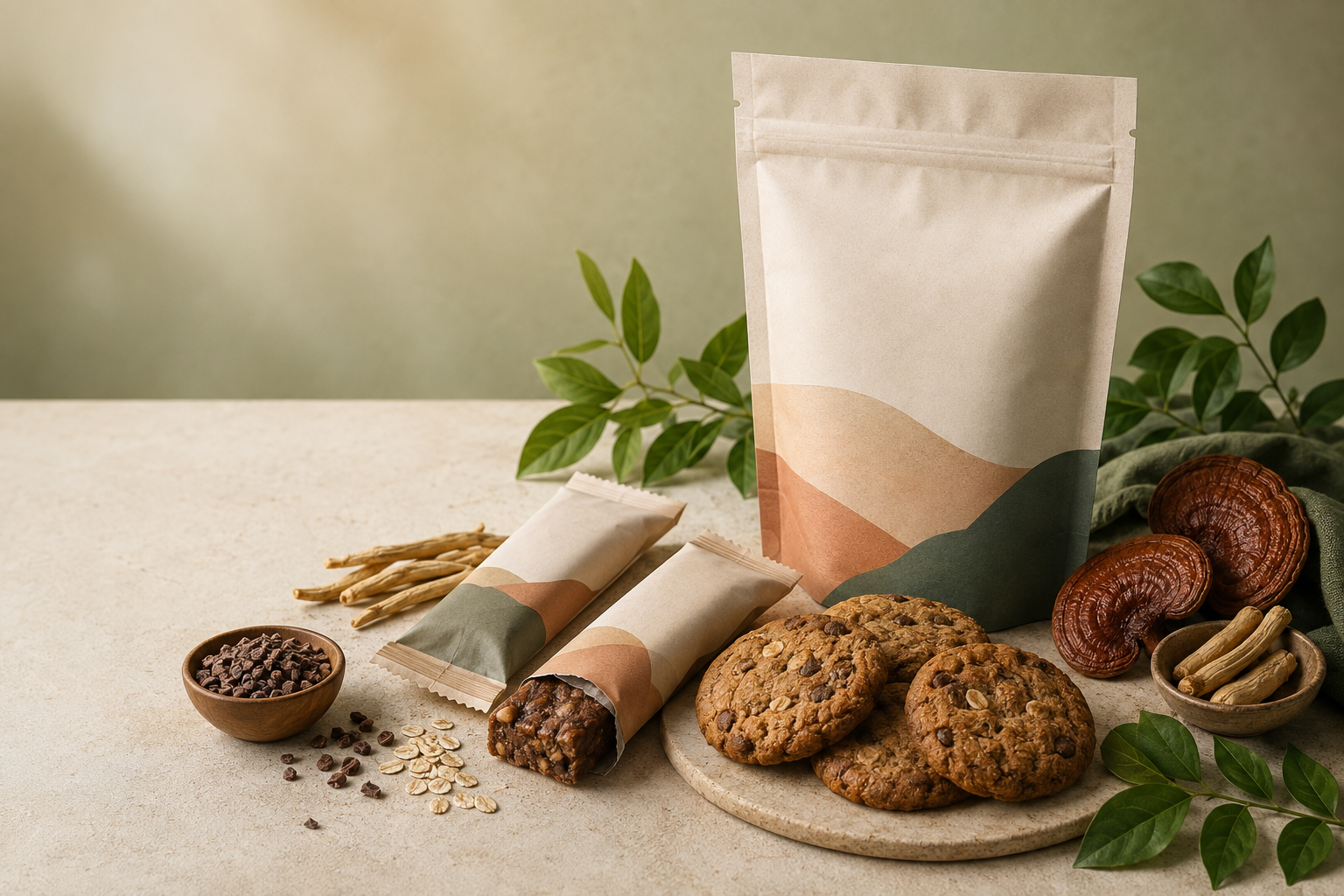
A case study CPG brand adaptogenic cookies or bars strategy reveals a challenge facing many functional-food companies: consumers may be interested in adaptogens, but curiosity alone does not create repeat purchases.
Successful brands have to translate an unfamiliar functional ingredient into a product people immediately understand, trust, enjoy, and can easily fit into an existing routine.
This case study examines how an emerging adaptogenic snack brand can move from a niche wellness concept to a commercially viable consumer packaged goods (CPG) product. Rather than presenting invented sales figures as real results, it uses a representative brand scenario to show the positioning, product, retail, marketing, and measurement decisions that matter most.
Quick Facts
Category: Functional snacks / better-for-you CPG
Products: Adaptogenic cookies and snack bars
Primary challenge: Turning ingredient awareness into everyday demand
Core opportunity: Combine familiar snack formats with credible functional benefits
Primary channels: DTC, specialty retail, natural grocery, marketplaces
Key metrics: Trial, repeat purchase, velocity, gross margin, CAC, AOV, and retention
The Market Opportunity Behind Adaptogenic Snacks
Adaptogens have moved beyond supplements and powders into beverages, chocolates, gummies, cookies, bars, and other everyday formats.
That transition creates an important CPG opportunity. Instead of asking consumers to add another capsule or tincture to their routine, brands can place functional ingredients inside products consumers already know how to buy and use.
But there is a strategic catch.
People generally understand what a chocolate chip cookie or protein bar is. An “adaptogenic cookie” introduces another layer of decision-making:
- What makes it adaptogenic?
- What ingredients does it contain?
- Why would I eat it?
- How is it different from an ordinary snack?
- Does it taste good?
- How often should I consume it?
- Are the claimed benefits credible?
The brands that answer these questions quickly have a much better chance of converting wellness interest into actual purchases.
The Case Study Scenario
Consider a fictional emerging CPG company we’ll call Root & Rise.
The company develops packaged cookies and snack bars using recognizable food ingredients alongside selected botanicals and functional ingredients. Its initial audience consists of wellness-conscious adults who want convenient snacks but are increasingly skeptical of products that make exaggerated health claims.
The brand enters the market with two potential hero formats:
| Factor | Adaptogenic Cookies | Adaptogenic Bars |
|---|---|---|
| Consumer familiarity | Very high | Very high |
| Functional-food association | Moderate | High |
| Indulgence positioning | Strong | Moderate |
| On-the-go convenience | High | Very high |
| Protein opportunity | Moderate | High |
| Dessert replacement | Strong | Moderate |
| Competitive differentiation | Potentially high | More difficult |
| Habit potential | Snack/treat occasions | Snack, work, gym, travel |
| Retail education required | Moderate | Moderate |
Neither format automatically wins.
The better choice depends on the consumer occasion the brand intends to own.
Challenge 1: Positioning the Product Around an Occasion
One of the easiest mistakes in functional CPG is building the entire positioning around an ingredient.
Consumers rarely wake up thinking:
“I need to buy an adaptogen today.”
They are more likely to think:
“I need something for the afternoon.”
“I want a snack for work.”
“I want something sweet without buying conventional cookies.”
“I need something convenient for my bag.”
This distinction changes the marketing strategy.
Sell the Moment Before the Ingredient
Root & Rise could position its products around recognizable consumption occasions such as:
- the mid-afternoon snack;
- a desk-drawer alternative;
- an on-the-go breakfast companion;
- a post-lunch treat;
- a travel snack;
- an evening snack ritual.
The adaptogenic ingredient then becomes part of the product’s differentiation rather than the entire reason the category exists.
This is especially important when marketing to consumers who are not already immersed in wellness culture.
Challenge 2: Making Adaptogens Understandable
Functional ingredients can create differentiation while simultaneously increasing purchase friction.
A package crowded with unfamiliar botanical terminology forces shoppers to work too hard.
The better approach is a hierarchy of information.
Level 1: What Is It?
Lead with the recognizable product.
Soft-Baked Oat Cookie
or:
Chocolate Almond Snack Bar
Level 2: What Makes It Different?
Introduce the functional distinction.
For example:
Made with Ashwagandha
or:
Functional Snack with Adaptogenic Botanicals
Level 3: Why Should Consumers Care?
Any benefit communication should be specific, responsible, substantiated, and compliant with applicable food-labeling and advertising requirements.
Brands should avoid turning nuanced ingredients into sweeping promises.
Statements implying that a food treats anxiety, cures medical conditions, prevents disease, or produces guaranteed physiological outcomes can create both credibility and regulatory problems.
Challenge 3: Taste Still Has to Win
Functional-food founders sometimes overestimate how much compromise consumers will accept for a perceived wellness benefit.
For a mainstream snack, taste is not a secondary feature.
It is the product.
Adaptogenic ingredients therefore need to work within a formulation that maintains:
- flavor;
- aroma;
- texture;
- sweetness balance;
- mouthfeel;
- shelf stability;
- consistency between production batches.
If a consumer tries an adaptogenic cookie once because the concept sounds interesting but never buys it again because of bitterness or poor texture, the brand has acquired attention—not a customer.
The Repeat-Purchase Test
The most useful product-development question is not:
“Would someone try this?”
It is:
“Would someone choose this again when the functional novelty disappears?”
That question should guide formulation decisions before significant money is committed to customer acquisition.
Cookies vs. Bars: Which Format Makes More Sense?
For a new brand deciding between the two, the answer depends primarily on positioning.
Choose Adaptogenic Cookies When:
- indulgence is central to the brand;
- taste differentiation is a major advantage;
- the product replaces conventional sweets;
- the brand wants to challenge perceptions of functional foods;
- gifting or multipack consumption matters.
Cookies can create an attractive contrast: an emotionally familiar treat combined with modern functional-food positioning.
Choose Adaptogenic Bars When:
- portability is the primary use case;
- protein or nutritional density is important;
- consumers need an obvious daily occasion;
- convenience retail is strategically important;
- the brand wants to compete in active or performance-adjacent categories.
Bars benefit from an already established consumer expectation that a compact snack can contain functional ingredients.
Consider Both Only After Establishing a Hero Product
Launching cookies and bars simultaneously sounds like diversification, but for an early-stage brand it can create unnecessary complexity.
Every additional SKU can affect:
- ingredient procurement;
- manufacturing;
- packaging;
- inventory;
- forecasting;
- merchandising;
- marketing budgets;
- retail sales conversations.
A stronger strategy is often to prove one product and consumption occasion before expanding.
Building a Stronger CPG Value Proposition
Root & Rise needs a proposition that works even if a shopper knows almost nothing about adaptogens.
A useful positioning framework is:
Familiar product + desirable experience + credible functional differentiation.
For example:
A satisfying afternoon snack made with thoughtfully selected functional ingredients.
This is generally easier to understand than positioning based entirely on botanical terminology.
Three Questions Every Package Should Answer
A shopper looking at the front and back of the package should quickly understand:
- What is this product?
- Why is it different?
- Why should I choose it over my usual snack?
If those answers require a long website explanation, the positioning probably needs more work.
Packaging Strategy for Adaptogenic Cookies or Bars
CPG packaging has to perform multiple jobs at once.
It must attract attention, communicate the category, differentiate the brand, support compliance, and help shoppers make a decision in seconds.
Front-of-Pack Priorities
A functional snack package should generally prioritize:
- brand name;
- product type;
- flavor;
- key differentiator;
- relevant factual nutritional information;
- net quantity.
The exact hierarchy depends on the product and market.
Don’t Turn the Package Into a Wellness Dictionary
Brands can become so excited about ingredients that packaging becomes overloaded with badges, benefits, botanical names, and explanations.
That often weakens the main message.
A better rule is:
Front of package creates understanding. Back of package creates depth.
QR codes and the product website can provide additional ingredient education for shoppers who want it.
Creating Credibility in a Skeptical Wellness Market
Trust is especially important for products associated with wellness.
Consumers have been exposed to countless products promising dramatic improvements in energy, stress, focus, sleep, metabolism, and performance.
An emerging brand should differentiate through evidence and transparency rather than louder promises.
Practical Trust Signals
Depending on the product, useful signals may include:
- transparent ingredient quantities;
- clear nutrition information;
- sourcing details;
- manufacturing standards;
- allergen information;
- third-party testing where relevant;
- accessible FAQs;
- realistic product descriptions;
- citations to appropriate research when discussing ingredients.
Scientific research on an individual ingredient should not automatically be presented as proof that the finished cookie or bar produces the same result.
Dosage, formulation, population, study design, and delivery method all matter.
That distinction is an important component of responsible functional-food marketing.
The Go-to-Market Strategy
A young CPG brand usually needs to prove several things before aggressive retail expansion.
It needs evidence that consumers will try the product, like it, purchase it again, and recommend it.
Phase 1: Direct-to-Consumer Validation
DTC provides an opportunity to test:
- positioning;
- flavors;
- pricing;
- bundles;
- landing pages;
- creative concepts;
- customer objections;
- subscription potential.
Instead of viewing the website purely as a sales channel, Root & Rise should treat it as a research environment.
Customer reviews, post-purchase surveys, support questions, repeat-purchase data, and conversion behavior can reveal which messages actually resonate.
Phase 2: Local and Specialty Retail
Once the product has stronger evidence of demand, specialty stores and independent retailers can provide useful offline validation.
The objective is not simply getting onto shelves.
It is getting off them.
That means measuring retail velocity rather than celebrating distribution alone.
Phase 3: Broader Retail Expansion
Larger retail expansion makes more sense when the brand understands:
- its strongest SKUs;
- expected velocity;
- retailer margins;
- distributor economics;
- promotional requirements;
- production capacity;
- shelf life;
- replenishment cycles.
Rapid distribution without sufficient consumer pull can create expensive inventory problems.
Sampling Can Be a Major Growth Lever
Adaptogenic cookies and bars are unusually suitable for sampling because taste is one of the biggest barriers to purchase.
A shopper may hesitate to pay premium pricing for a full box of an unfamiliar functional snack.
A sample removes much of that uncertainty.
Strategic sampling opportunities include:
- wellness events;
- coworking spaces;
- boutique fitness studios;
- cafés;
- corporate offices;
- university campuses where appropriate;
- specialty retailers;
- complementary brand collaborations.
But sampling should be measurable.
QR codes, dedicated landing pages, unique promotional codes, or post-event surveys can help determine whether trial converts into purchasing behavior.
Content Marketing Should Educate Without Overwhelming
Search can play an important role because consumers often research functional ingredients before buying.
The brand should therefore build content around questions people actually have rather than publishing generic “wellness tips.”
Potential content clusters include:
Adaptogen Education
- What are adaptogens?
- How are adaptogens used in foods?
- Adaptogens vs. functional mushrooms
- What should consumers look for in functional snacks?
Ingredient Education
Each important ingredient can have its own evidence-aware resource explaining:
- what it is;
- where it comes from;
- why the brand selected it;
- how it is used in the product;
- relevant research;
- important limitations.
Product and Occasion Content
Commercial content should answer searches closer to purchase:
- adaptogenic snacks;
- functional cookies;
- functional snack bars;
- healthy alternatives to conventional cookies;
- snacks for busy workdays;
- functional snacks for travel.
This creates a search ecosystem instead of relying on a single product page to rank for every relevant query.
Influencer Marketing: Prioritize Credibility Over Reach
Functional-food brands are naturally compatible with creator marketing, but follower count alone is a weak selection criterion.
Root & Rise should prioritize creators whose audiences trust their food and wellness recommendations.
Potential creator categories include:
- registered dietitians;
- food creators;
- fitness creators;
- wellness educators;
- productivity creators;
- lifestyle creators;
- busy-parent creators.
Health-related content requires additional care. Creator scripts and talking points should not encourage unsupported medical claims simply because stronger claims generate more clicks.
Measure Creator Performance Beyond Views
Track:
- cost per first purchase;
- conversion rate;
- new-customer revenue;
- average order value;
- repeat purchases by acquired cohort;
- creator-specific discount usage;
- branded search lift.
A creator generating 100,000 views and few repeat customers may be less valuable than a smaller creator consistently attracting high-retention buyers.
Bundling Can Solve the Premium-Price Problem
Functional ingredients and specialized manufacturing can push product costs above conventional snack alternatives.
That creates price resistance.
Instead of depending heavily on discounts, Root & Rise could test:
- variety packs;
- discovery boxes;
- cookie-and-bar bundles;
- multipacks;
- subscribe-and-save offers;
- limited seasonal flavors.
Bundles can increase average order value while helping consumers explore the product line.
They can also reduce the psychological impact of comparing one premium functional snack directly against one conventional snack.
Subscription Should Follow Habit, Not Precede It
Subscriptions are attractive because recurring revenue improves predictability.
But consumers do not subscribe because a brand wants recurring revenue.
They subscribe because they have developed a recurring consumption habit.
Root & Rise should therefore determine:
- how frequently customers naturally consume the product;
- how long a typical package lasts;
- when repeat orders occur;
- which SKUs generate the highest repeat rates.
Subscription timing should reflect observed behavior rather than an arbitrary 30-day schedule.
Retail Strategy: Distribution Is Not the Primary KPI
CPG companies frequently highlight the number of stores carrying their products.
That number can be misleading.
A more meaningful question is:
How quickly does each store sell the product?
Important retail metrics include:
- units per store per week;
- revenue per store;
- reorder frequency;
- out-of-stock rate;
- promotional lift;
- SKU-level velocity;
- retailer retention.
A product selling consistently in 100 stores may have stronger fundamentals than a product struggling across 1,000 locations.
Metrics That Matter Most
A credible case study CPG brand adaptogenic cookies or bars analysis should connect marketing activity to business outcomes.
| Metric | What It Reveals |
| Conversion rate | Ability to turn traffic into customers |
| CAC | Cost of acquiring a new customer |
| AOV | Initial order economics |
| Gross margin | Financial viability before operating expenses |
| Repeat purchase rate | Whether consumers actually want more |
| Time to second purchase | Natural replenishment cycle |
| LTV | Longer-term customer value |
| Retail velocity | Shelf-level consumer demand |
| Sampling conversion | Effectiveness of product trial |
| SKU mix | Which products drive the business |
No single metric tells the complete story.
A low customer acquisition cost is not necessarily good if those customers never return.
Likewise, strong retention cannot compensate indefinitely for acquisition economics that make growth unprofitable.
The Most Important Metric: Repeat Purchase
Functional CPG can generate impressive first-purchase performance because novelty creates curiosity.
Repeat purchase reveals something more valuable.
It indicates whether the product has earned a place in the consumer’s routine.
If repeat purchase is weak, Root & Rise should investigate:
- taste;
- texture;
- price;
- portion size;
- packaging;
- product experience;
- unclear consumption occasions;
- weak perceived value;
- competitive alternatives.
Spending more on advertising before diagnosing weak retention can amplify the underlying problem.
Common Mistakes Adaptogenic CPG Brands Should Avoid
1. Selling Ingredients Instead of Products
Consumers should not need specialist knowledge to understand why the product belongs in their pantry.
Lead with the food and occasion. Use functional ingredients to strengthen differentiation.
2. Making Benefits Sound Like Medical Guarantees
Aggressive claims may create short-term attention while undermining trust and increasing regulatory risk.
Claims should be accurate, appropriately qualified, substantiated, and compliant with the rules governing the markets where the product is sold.
3. Treating Taste as Secondary
A functional snack still competes against delicious snacks.
Consumers have many alternatives and little reason to tolerate an unpleasant product indefinitely.
4. Launching Too Many SKUs
More flavors can create the appearance of growth while fragmenting inventory and marketing resources.
Prove a hero SKU first.
5. Expanding Retail Before Creating Demand
Getting a buyer to authorize the product is only half the challenge.
Consumers still need a reason to take it off the shelf.
6. Using Discounts as the Primary Acquisition Strategy
Constant promotions can train customers to wait for lower prices.
Sampling, bundles, education, referrals, and strong product differentiation can create more sustainable reasons to purchase.
7. Ignoring Post-Purchase Research
Customer acquisition data explains how people arrived.
Post-purchase research can explain why they bought.
Ask customers what convinced them, what almost stopped them, what they expected, how they use the product, and whether they intend to repurchase.
A Better 90-Day Growth Framework
For an emerging adaptogenic cookie or bar brand, a focused 90-day plan could look like this.
Days 1–30: Validate the Message
Focus on the hero product and identify the strongest consumer problem or occasion.
Test:
- landing-page positioning;
- product photography;
- ingredient explanations;
- pricing;
- introductory bundles;
- ad creative;
- customer FAQs.
Interview both buyers and non-buyers when possible.
Days 31–60: Validate Repeatability
Shift attention from first-order conversion toward customer quality.
Analyze:
- repeat purchase;
- product reviews;
- second-order timing;
- cohort behavior;
- favorite flavors;
- reasons for churn.
At the same time, test targeted sampling and micro-creator partnerships.
Days 61–90: Prepare for Scale
Once the brand has evidence that consumers return, strengthen the systems required for broader growth.
That includes:
- inventory forecasting;
- production capacity;
- contribution-margin modeling;
- retail sales materials;
- merchandising;
- retention campaigns;
- SEO content;
- creator partnerships;
- sampling programs.
Scaling should amplify demonstrated demand—not compensate for the absence of it.
What a Successful Adaptogenic Snack Brand Ultimately Sells
The most important strategic insight is that consumers do not necessarily want more functional ingredients.
They want products that fit their lives.
The winning proposition may therefore be less about selling “adaptogens” and more about delivering:
a convenient snack that tastes good, fits a recognizable moment, communicates its ingredients clearly, and offers credible functional differentiation.
That shift sounds subtle, but it influences almost everything: formulation, packaging, copywriting, advertising, retail strategy, and retention.
Key Takeaways From This CPG Case Study
A strong adaptogenic cookie or bar brand should:
- Own a consumption occasion, not merely an ingredient trend.
- Make the product understandable within seconds.
- Prioritize taste and repeat purchase over novelty.
- Communicate functional benefits responsibly.
- Launch a focused hero SKU before expanding aggressively.
- Use sampling to overcome taste and price uncertainty.
- Measure retail velocity instead of distribution alone.
- Use DTC data to refine positioning before larger retail expansion.
- Build subscriptions around demonstrated consumption habits.
- Treat repeat purchase as one of the clearest signals of product-market fit.
Final Thoughts
The central lesson from this case study CPG brand adaptogenic cookies or bars framework is simple: functional ingredients can win the first moment of attention, but the complete product experience determines whether a brand becomes sustainable.
Adaptogenic cookies and bars have an appealing position at the intersection of familiar snacking and functional wellness. Yet long-term growth depends on more than following that trend. Brands need exceptional taste, clear positioning, responsible claims, disciplined SKU management, strong unit economics, measurable retail velocity, and—above all—customers who genuinely want to buy the product again.
For CPG founders and marketers entering this category, the smartest strategy is to prove the habit before pursuing the hype.
