
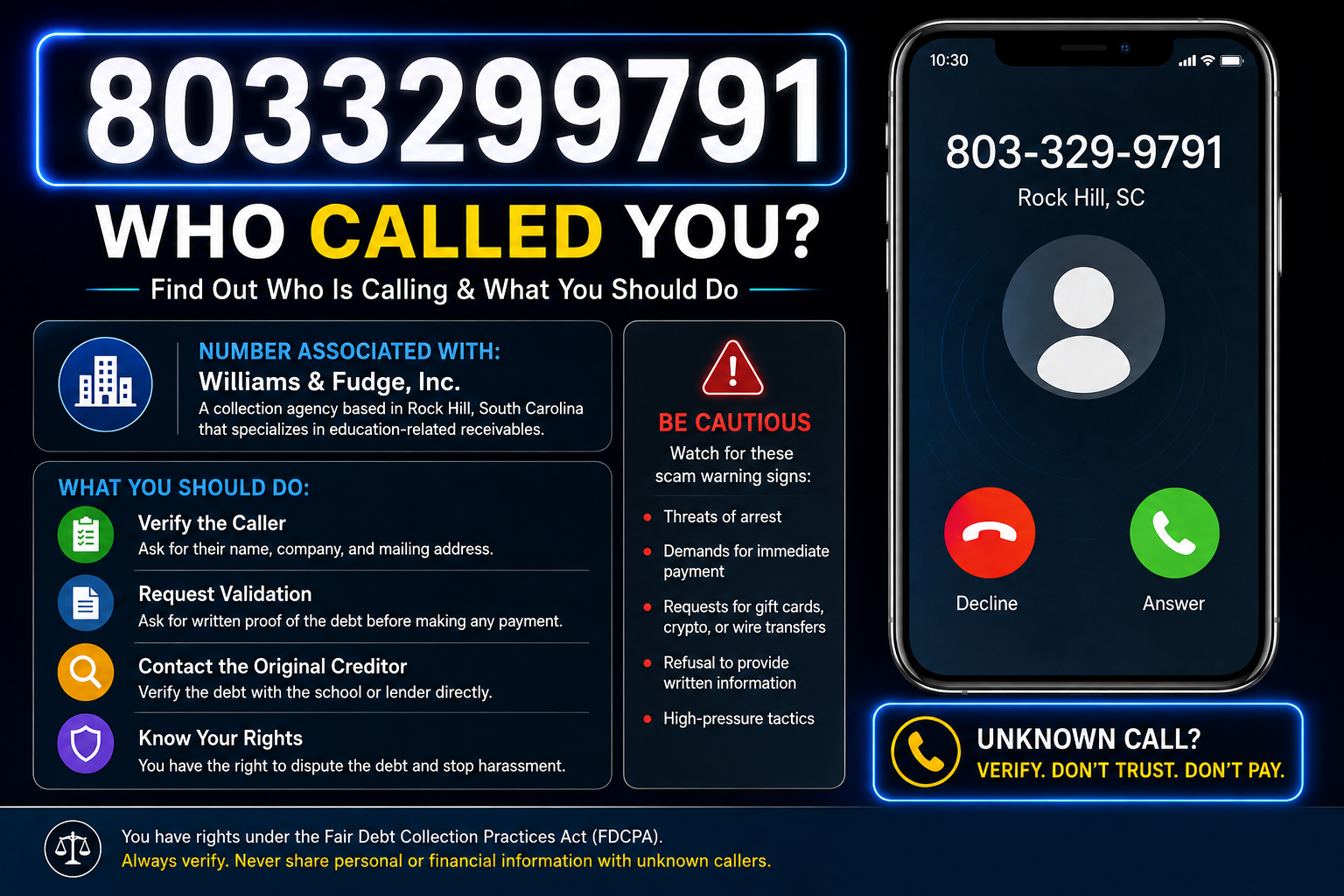
Receiving an unexpected call from 8033299791 can be unsettling, especially when the caller mentions an unpaid account, student loan, collection balance, or urgent payment deadline.
Publicly available records associate 803-329-9791 with Williams & Fudge, Inc., a debt-collection company based in Rock Hill, South Carolina. However, the number appearing on your screen does not automatically prove that the person calling is an authorized company representative.
Caller ID information can be manipulated through spoofing. Before sharing personal information or making a payment, verify both the caller and the alleged debt independently.
Quick Facts About 8033299791
| Detail | Available information |
|---|---|
| Formatted number | 803-329-9791 |
| Area code | 803 |
| General location | South Carolina, United States |
| Publicly associated organization | Williams & Fudge, Inc. |
| Likely call category | Debt collection or account servicing |
| Safe to answer? | Answer cautiously and verify the caller |
| Pay immediately? | No—request and review validation information first |
A South Carolina government contract record lists (803) 329-9791 as a telephone number for Williams & Fudge, Inc. at 300 Chatham Avenue in Rock Hill. The company’s current website identifies the same business name and address and describes its work in student-loan and receivables collection.
Who Is Behind 8033299791?
The strongest publicly available evidence links 8033299791 to Williams & Fudge, Inc.
Williams & Fudge presents itself as a receivables-management and collection company serving educational institutions and financial-services organizations. Its official website lists services connected with student accounts, student loans, receivables, and financial-services collections.
Independent consumer and legal-information websites also associate 803-329-9791 with Williams & Fudge. These third-party listings should be treated as supporting evidence rather than absolute proof of who placed a particular call.
Why the identification is not guaranteed
A legitimate organization may own or use a phone number while a scammer displays that same number through caller ID spoofing.
The Federal Trade Commission warns that scammers can falsify caller ID information to make a call appear to come from a real company, government agency, local business, or trusted telephone number. Therefore, seeing 8033299791 on your screen is not sufficient verification by itself.
Why Might 8033299791 Be Calling You?
A call associated with a collection company does not necessarily mean that you currently owe a valid debt. Several explanations are possible.
An account may have been placed for collection
A school, lender, service provider, or other creditor may have transferred an unpaid account to a collection agency.
The caller should be able to identify:
- The collection company
- The original or current creditor
- The amount allegedly owed
- The account associated with the balance
- How to dispute or request verification
The call may concern an educational account
Because Williams & Fudge works with educational institutions and student-related receivables, the call could involve tuition, institutional charges, a student account, or another education-related balance.
Do not assume the claim is accurate simply because the caller knows the name of a school you attended. Personal and account information can be outdated, incorrect, obtained from previous records, or misused by impersonators.
The collector may have the wrong person
Debt collectors sometimes contact people whose names resemble those of the intended consumer. A telephone number may also have previously belonged to someone else.
Tell the caller clearly that they may have the wrong number. Avoid giving your Social Security number, full date of birth, banking credentials, or other sensitive details merely to prove that you are not the person they want.
The debt may already have been paid or disputed
Records can be delayed or transferred with incomplete information. You might receive a call about an account that was:
- Paid directly to the creditor
- Included in a settlement
- Discharged or otherwise resolved
- Reported under the wrong balance
- Previously disputed
- Associated with identity theft
Keep receipts, account statements, settlement letters, dispute records, and related correspondence.
Someone may be impersonating the company
A fraudulent caller could display 8033299791 while demanding money through an unusual or irreversible payment method.
Possible warning signs include:
- Threatening immediate arrest
- Claiming police are already on the way
- Refusing to provide written information
- Demanding gift cards or cryptocurrency
- Asking for payment through a personal transfer account
- Pressuring you to act before speaking with anyone else
- Refusing to identify the original creditor
- Requesting a one-time password or online banking login
The FTC states that legitimate debt collectors cannot threaten arrest merely because a consumer has not paid a bill. Consumers should obtain validation information before agreeing to pay an unfamiliar debt.
What to Do After a Call From 8033299791
Follow a verification process instead of ignoring the issue or paying under pressure.
1. Record the basic details
Write down:
- The date and time of the call
- The number displayed
- The caller’s name
- The company name provided
- The original creditor named
- The amount claimed
- Any callback number or extension
- Exactly what the caller requested
- Any threats or deadlines mentioned
Save related voicemails, text messages, emails, and letters. Your notes may become important if the calls continue or the information changes.
2. Ask for validation information
A debt collector is generally required to provide specified information about the alleged debt during the initial communication or within five days.
Validation information should identify the creditor, the amount claimed, and the consumer’s dispute rights. If the collector cannot or will not provide this information, treat the situation cautiously.
Ask for the information in writing. Do not let an artificial “today only” deadline force you into an immediate payment.
3. Verify the company independently
Do not rely exclusively on the callback number, website, email address, or payment link supplied during an unexpected call.
Look up the organization through:
- Its official website
- A state licensing authority
- Your original creditor
- A recent statement or authenticated customer portal
- A recognized government or regulatory database
Williams & Fudge’s official website currently lists its Rock Hill address and a toll-free contact number. Using independently sourced contact information reduces the risk of returning a call to an impersonator.
4. Contact the original creditor
Ask the original creditor whether:
- Your account was assigned or transferred
- Williams & Fudge is authorized to handle it
- The stated balance is accurate
- The account number matches its records
- Payments should be made through the collector or creditor
Use the contact information on an official statement, authenticated portal, or creditor website—not information supplied only by the caller.
5. Review the written notice carefully
Compare the notice with your own records.
Check:
- Your name and mailing address
- The creditor’s name
- The account reference
- The itemized balance
- Interest, fees, payments, and credits
- Relevant dates
- Instructions for disputing the debt
Do not ignore discrepancies. Even a legitimate collection company can receive incorrect or incomplete account data.
6. Dispute an unrecognized or incorrect debt
According to the Consumer Financial Protection Bureau, consumers generally have 30 days after receiving validation information to dispute the debt in writing and request verification. Missing that period may affect how certain protections under the federal collection rule apply.
A dispute should clearly state whether you challenge:
- The entire debt
- Part of the balance
- The identity of the creditor
- Ownership of the account
- Added fees or interest
- The claim that the account belongs to you
Send correspondence using a trackable method and keep copies of everything.
What Not to Say During the First Call
You do not need to argue about the account during an unexpected telephone conversation.
Avoid making statements such as:
- “Yes, that is definitely my debt.”
- “I promise I will pay on Friday.”
- “Take the money from this bank account.”
- “My Social Security number is…”
- “My card details are…”
A safer response is:
“I do not make payments or confirm accounts during unsolicited calls. Please send the required validation information in writing. I will review it and respond through verified contact channels.”
This keeps the conversation controlled without admitting or denying an account before reviewing the evidence.
Your Rights When Dealing With Debt-Collection Calls
The Fair Debt Collection Practices Act and the CFPB’s Debt Collection Rule establish protections for consumers dealing with qualifying third-party collectors.
Protection from harassment
Collectors cannot repeatedly call with the intent to annoy, abuse, or harass.
Under the federal rule, a collector is generally presumed to violate the frequency restriction when it places more than seven calls within seven consecutive days concerning a particular debt or calls within seven days after having a telephone conversation about that debt, subject to exclusions and specific circumstances.
Restrictions on calling times
Collectors are generally prohibited from calling before 8:00 a.m. or after 9:00 p.m. in the consumer’s local time.
They must also consider instructions about inconvenient places or times, including personal collection calls at work when the collector knows such calls are prohibited or inconvenient.
Protection from false threats
A collector cannot lawfully use deception, abusive language, threats of violence, or false claims of immediate arrest.
Unpaid consumer debt can have serious consequences, including credit reporting or a civil lawsuit in some situations. However, a caller cannot bypass the legal process by simply declaring that police will arrest you unless you pay during the call.
The right to request limited or stopped communication
Consumers may instruct a collector not to call at certain times or places. They may also request that collection communications stop, although stopping calls does not erase a valid debt or prevent legally permitted actions.
Put important communication requests in writing and retain proof of delivery.
Should You Block 8033299791?
Blocking 8033299791 may be reasonable when:
- The caller refuses to provide validation information
- The calls are for another person
- The communication appears fraudulent
- The caller repeatedly uses threats or abusive language
- You have requested written communication only
- Calls continue after you have documented your instructions
However, blocking the number should not replace investigating a potentially legitimate account. A valid debt can still affect your credit or become the subject of legal proceedings even when telephone calls are blocked.
A balanced approach is to preserve evidence, request written information, verify the account, and then decide how future communication should occur.
Is 8033299791 a Scam Number?
It would be inaccurate to label 8033299791 automatically as a scam number.
Public records connect the number to Williams & Fudge, Inc., and the company itself appears to be an established collection business.
Nevertheless, a specific call could still be suspicious because:
- Caller ID can be spoofed.
- A legitimate collector may have incorrect account information.
- A collector may be seeking someone who previously used your number.
- A scammer may impersonate a real business.
- The debt may be outdated, paid, duplicated, or connected to identity theft.
The correct question is not simply, “Is the number real?” The more useful question is, “Can the caller independently prove their identity and validate the account?”
Red Flags Versus Signs of a Verifiable Call
| More consistent with verification | Potential warning sign |
| Provides company name and mailing address | Refuses to identify the company |
| Sends validation information | Demands payment without documentation |
| Identifies the creditor and itemized balance | Cannot explain where the debt originated |
| Allows time to review the information | Creates an immediate artificial deadline |
| Accepts a written dispute | Threatens punishment for asking questions |
| Uses an established payment channel | Demands gift cards, crypto, or a personal transfer |
| Encourages independent verification | Insists you use only a supplied link or number |
No single item proves legitimacy. Evaluate the entire interaction and confirm the account through independent records.
How to Report Suspicious or Abusive Calls
Report the incident when the caller appears fraudulent, makes illegal threats, repeatedly harasses you, or refuses to provide basic collection information.
Possible reporting channels include:
- The Consumer Financial Protection Bureau
- The Federal Trade Commission
- The Federal Communications Commission for unwanted calls or spoofing
- Your state attorney general
- Your state financial or collection-agency regulator
- Your telephone carrier
The FTC advises consumers to report fake or abusive debt collectors, while the FCC accepts complaints involving unwanted calls, texts, and caller ID spoofing.
Include dates, call times, recordings where legally permitted, voicemails, screenshots, payment instructions, and copies of written correspondence.
Frequently Asked Questions
Is 8033299791 connected to Williams & Fudge?
Public records and multiple directories associate 803-329-9791 with Williams & Fudge, Inc. A South Carolina government record lists the number with the company’s Rock Hill address.
Because caller ID can be spoofed, independently contact the company before treating a particular call as authentic.
What kind of company is Williams & Fudge?
Williams & Fudge describes itself as a company providing student-loan, financial-services, and receivables-collection services.
Should I call 8033299791 back?
You may speak with the organization, but the safer approach is to obtain contact information from its official website or another reliable independent source.
Do not use a callback number or payment link merely because it appeared in a voicemail.
Should I give the caller my date of birth or Social Security number?
Do not provide highly sensitive information during an unexpected call. First establish the company’s identity through an independent channel.
A legitimate collector may need to confirm that it is speaking with the correct consumer, but you should not disclose enough information for identity theft or account takeover.
Can I ask the caller to stop contacting me?
You may request restrictions on communications or ask the collector to stop contacting you. A written request creates a clearer record.
Remember that stopping communication does not cancel a valid debt.
What happens if the debt is mine?
Confirm the balance and ownership first. Then review realistic options such as payment in full, a payment arrangement, or a negotiated settlement.
Obtain every agreement in writing before sending money. The agreement should explain the amount, due dates, settlement terms, and how the account will be reported or closed.
What if the debt is not mine?
Dispute it in writing and request verification. You may also need to review your credit reports and investigate possible identity theft if unfamiliar accounts appear under your identity.
Final Verdict on 8033299791
Available public information links 8033299791 to Williams & Fudge, Inc., a Rock Hill-based company involved in student-loan and receivables collection. That association makes a genuine collection call possible, but it does not authenticate every call displaying the number.
Do not pay solely because the caller sounds convincing or knows personal details. Request validation information, verify the organization independently, contact the original creditor, preserve your records, and dispute anything you do not recognize.
The safest response to 8033299791 is neither panic nor automatic dismissal. It is careful, documented verification before sharing sensitive information, admitting responsibility, or making a payment.
