
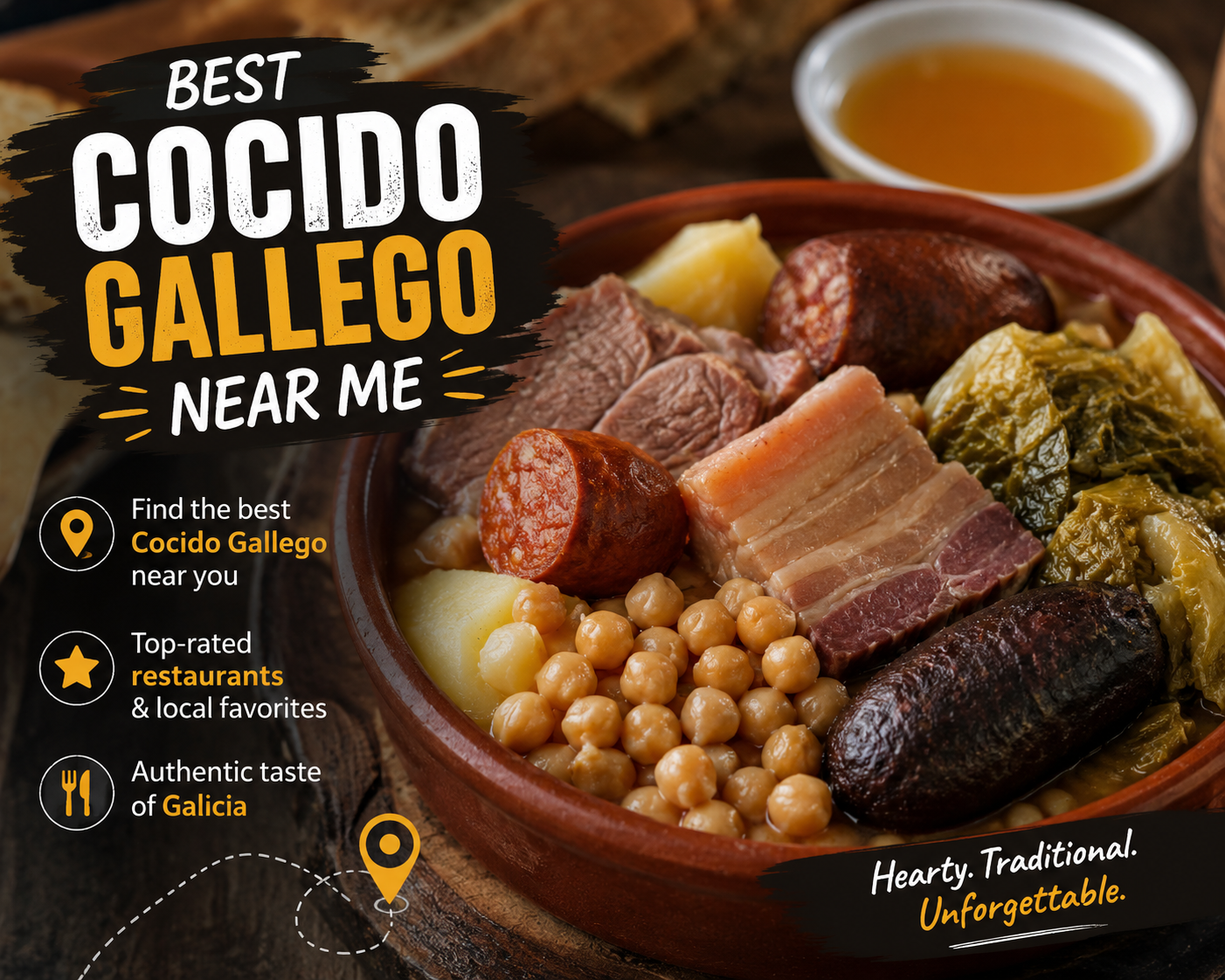
Searching for the best cocido gallego near me usually means you want more than an ordinary stew. You are looking for a comforting Galician meal made with tender meats, creamy beans, potatoes, vegetables, and a rich broth that tastes as though it has been simmering all day.
The challenge is that not every Spanish restaurant prepares cocido gallego traditionally. Some serve it only during winter, some require advance reservations, and others offer modern versions that may leave out important ingredients.
This guide explains how to locate authentic cocido gallego nearby, compare restaurants, understand the dish, and order the right portion without wasting time or money.
Quick Facts About Cocido Gallego
| Feature | What to Expect |
|---|---|
| Origin | Galicia, northwestern Spain |
| Dish type | Slow-cooked meat, bean, potato, and vegetable stew |
| Common meats | Pork shoulder, ribs, chorizo, bacon, or salted pork |
| Traditional beans | White beans |
| Common vegetables | Potatoes, turnip greens, cabbage, or kale |
| Best season | Autumn and winter |
| Serving style | One large bowl or several separate courses |
| Portion size | Usually generous and filling |
| Availability | Often seasonal or offered as a weekend special |
What Is Cocido Gallego?
Cocido gallego is a traditional dish from Galicia, a region in northwestern Spain known for hearty rural cooking. It brings together meat, beans, potatoes, greens, and broth in a slow-cooked meal designed to be satisfying and warming.
There is no single recipe followed by every family or restaurant. Ingredients can change depending on the cook, season, and local availability.
A traditional version may include:
- Pork shoulder or pork ribs
- Chorizo
- Bacon or salted pork
- White beans
- Potatoes
- Turnip greens
- Cabbage or kale
- A deeply flavored cooking broth
The ingredients may look simple, but the quality of the dish depends heavily on cooking time, meat selection, seasoning, and balance.
What Does Authentic Cocido Gallego Taste Like?
A good cocido gallego should taste rich without being overwhelmingly salty or greasy. The broth absorbs flavor from the pork and chorizo, while the beans and potatoes provide a soft, comforting texture.
The greens are especially important. Their slightly bitter or earthy flavor prevents the meat and broth from becoming too heavy.
You should notice several layers of flavor:
- Smokiness from chorizo or cured pork
- Savory depth from slow-cooked meat
- Creaminess from white beans
- Earthiness from greens
- Mild sweetness from potatoes
- Warmth from the concentrated broth
An authentic version should feel rustic rather than overly refined. It is farmhouse food built around quality ingredients and patient cooking.
How to Find the Best Cocido Gallego Near Me
Finding a nearby restaurant is easy. Finding one that prepares the dish properly requires a little more research.
Search Using Specific Local Terms
A broad search may show tapas bars, Latin American restaurants, general Spanish restaurants, and businesses that do not actually serve cocido gallego.
Use more specific searches such as:
- Cocido gallego restaurant near me
- Authentic Galician restaurant near me
- Spanish stew near me
- Galician food in my city
- Cocido gallego weekend special
- Cocido gallego delivery near me
- Traditional Spanish cocido nearby
You can also add your city, neighborhood, or postal code to improve the results.
For example:
- Cocido gallego in Miami
- Galician restaurant in Queens
- Cocido gallego Madrid city center
- Traditional cocido near downtown Chicago
Check the Current Menu
Do not assume a restaurant serves cocido gallego simply because it specializes in Spanish food. Many restaurants focus on tapas, paella, grilled seafood, or regional dishes from other parts of Spain.
Open the restaurant’s current menu and search for:
- Cocido gallego
- Caldo gallego
- Cocido
- Galician stew
- Cocido especial
- Cocido completo
Pay attention to the exact name. Caldo gallego and cocido gallego are related, but they are not always the same dish.
Caldo gallego is commonly a lighter soup made with greens, potatoes, beans, and pork flavoring. Cocido gallego is generally a larger, more substantial meal with multiple cuts of meat.
Call Before Visiting
Cocido gallego often requires long preparation, so restaurants may not offer it every day. It might be available only during colder months, on weekends, or through advance ordering.
Ask the restaurant:
- Is cocido gallego available today?
- Is it served every day or only as a special?
- Does it require advance booking?
- What meats and vegetables are included?
- Is the portion designed for one person or multiple diners?
- Can it be ordered for takeaway?
- Is there a minimum number of guests?
A two-minute phone call can prevent an unnecessary journey.
Read Reviews Carefully
Star ratings alone do not tell you whether a restaurant makes excellent cocido gallego. Read the written reviews and search within them for specific words such as “cocido,” “Galician,” “stew,” “chorizo,” or “broth.”
The most helpful reviews usually mention:
- Whether the dish tasted homemade
- The quality and tenderness of the meat
- Portion size
- Broth flavor
- Freshness of the greens
- Waiting time
- Seasonal availability
- Value for money
Recent reviews are generally more useful because menus, chefs, portion sizes, and restaurant standards can change.
How to Recognize a Good Galician Restaurant
A restaurant does not need expensive décor to serve excellent cocido. In fact, some of the best traditional dishes are found in modest neighborhood establishments.
Look for signs of genuine regional knowledge.
The Menu Includes Other Galician Dishes
A restaurant may be more likely to understand cocido gallego if it also serves dishes associated with Galicia, such as:
- Pulpo a feira
- Empanada gallega
- Lacón con grelos
- Caldo gallego
- Pimientos de Padrón
- Galician-style octopus
- Tarta de Santiago
The presence of these dishes is not a guarantee, but it suggests the kitchen has experience with Galician cuisine.
The Restaurant Explains Seasonal Availability
Traditional cocido is often associated with colder weather and communal dining. A restaurant that offers it only during certain months may actually be respecting the dish’s seasonal nature.
Limited availability is not necessarily a weakness. It may indicate that the kitchen prepares cocido in proper batches instead of reheating a mass-produced version every day.
Staff Can Describe the Ingredients
Restaurant staff should be able to explain what is included in the dish. Be cautious if no one knows which meats, beans, or greens are used.
A knowledgeable answer might explain that the cocido contains pork ribs, chorizo, white beans, potatoes, and turnip greens, with ingredients served together or in stages.
The Restaurant Attracts Spanish or Galician Diners
Customer demographics should never be treated as definitive proof of quality. However, reviews from diners familiar with Galician cuisine can provide valuable context.
Comments comparing the meal to family cooking, regional traditions, or dishes eaten in Galicia are especially helpful.
Traditional Cocido Gallego vs. Restaurant Adaptations
Restaurants often adapt cocido to suit local ingredients, customer preferences, or kitchen limitations.
| Element | Traditional Style | Common Restaurant Adaptation |
| Meat | Several pork cuts and chorizo | One or two meats |
| Greens | Turnip greens | Cabbage, kale, or collard greens |
| Beans | White beans | Cannellini or local white beans |
| Serving | Ingredients may be separated | Everything served in one bowl |
| Portion | Large and communal | Individual serving |
| Cooking | Long, slow preparation | Smaller pre-cooked batches |
| Availability | Seasonal | Year-round or occasional special |
An adaptation is not automatically inferior. A restaurant can substitute kale for turnip greens and still produce a delicious, respectful version.
The more important questions are whether the ingredients are balanced, the broth has depth, and the meats have been cooked properly.
What to Look for When Your Cocido Arrives
Once the dish reaches your table, several details can help you judge its quality.
A Flavorful but Balanced Broth
The broth should be rich and aromatic. It should taste like meat and vegetables have been cooked together slowly, rather than like water mixed with excessive salt.
A thin broth may indicate rushed preparation. An extremely salty broth may come from poorly controlled cured meats.
Tender Meat
The pork should be tender enough to separate easily with a fork. It should not feel dry, rubbery, or undercooked.
Chorizo should add smoky seasoning without overpowering every other ingredient.
Creamy Beans That Hold Their Shape
The beans should be soft and creamy inside. They should not be hard, chalky, or completely dissolved into the broth.
A few broken beans are normal and can help thicken the dish naturally.
Properly Cooked Potatoes
Potatoes should be tender but not reduced to paste. They absorb the broth and provide a mild contrast to the stronger meat flavors.
Fresh-Tasting Greens
The greens should retain some character. Overcooked greens can become dull, stringy, or unpleasantly bitter.
Their purpose is not merely decorative. They are essential to the traditional balance of the meal.
How Cocido Gallego May Be Served
Serving style varies between restaurants.
Everything in One Bowl
This is the simplest presentation. Meat, beans, potatoes, greens, and broth are served together in a large bowl or deep plate.
It is convenient for individual diners and takeaway orders.
Broth First, Ingredients Second
Some restaurants begin with the broth or soup. The meats, vegetables, and potatoes are then served on a separate platter.
This approach allows diners to appreciate each component more clearly.
Family-Style Platter
Large portions may be presented for two or more people. The restaurant may place the meat on one platter, vegetables and potatoes on another, and broth in a separate bowl.
Always ask about portion size before ordering. A “serving for two” may be large enough for three people with moderate appetites.
How Much Does Cocido Gallego Cost?
The price depends on location, ingredients, portion size, and restaurant style. A casual neighborhood restaurant may offer it as an affordable lunch special, while a premium Spanish restaurant may charge more for imported ingredients or elaborate service.
Consider the complete value rather than looking only at the menu price.
Ask whether the meal includes:
- Bread
- Broth or soup
- Several cuts of meat
- Beans and vegetables
- Dessert
- Coffee
- A drink
- Multiple courses
A higher-priced cocido can still offer good value when it is large enough to share or includes several courses.
Questions to Ask Before Ordering
A few practical questions can improve your experience:
- Is the cocido made in-house?
- Which pork cuts are included?
- Does it contain beef or chicken?
- What type of beans are used?
- Are the greens turnip greens, cabbage, or kale?
- Is it very salty?
- Is the portion shareable?
- Can leftovers be packed?
- Does it contain gluten?
- Can any ingredients be removed?
Traditional cocido is not usually vegetarian, vegan, or pork-free. Its broth is commonly prepared with meat even when individual pieces are removed.
People with allergies or dietary restrictions should always confirm ingredients directly with the restaurant.
Dining In vs. Ordering Cocido Gallego for Delivery
Cocido can travel reasonably well, but delivery changes the experience.
Benefits of Dining In
- The broth arrives at the correct temperature.
- Meat and vegetables retain better texture.
- Separate-course service is possible.
- Staff can explain the ingredients.
- You can request extra broth or bread.
Benefits of Takeaway or Delivery
- Convenient for family meals
- Easy to reheat
- Suitable for large portions
- Leftovers can be stored immediately
- Useful when the restaurant is far away
For delivery, choose a restaurant that packages broth separately from meat and vegetables. This prevents potatoes and greens from becoming overly soft during transport.
Common Mistakes to Avoid
Choosing the Closest Restaurant Automatically
Distance is convenient, but the nearest Spanish restaurant may not serve Galician cuisine. Check the actual menu before deciding.
Confusing Cocido Gallego With Caldo Gallego
Caldo gallego is usually lighter and more soup-like. Cocido gallego is typically a heavier meal with more meat and larger components.
Read the description instead of relying only on the name.
Ignoring Seasonal Menus
A restaurant may have old photos or reviews showing cocido even though it is no longer available. Confirm the current menu directly.
Ordering Too Much Food
Cocido portions can be substantial. Ask whether the serving is intended for one person, two people, or a full table.
Expecting Every Recipe to Be Identical
Families and regions prepare cocido differently. A variation is not automatically inauthentic.
Judge the quality of the cooking and ingredients instead of rejecting every recipe that differs from one version you have tried.
Focusing Only on Presentation
Cocido is rustic food. It may not arrive with fine-dining plating, edible flowers, or artistic decoration.
Flavor, texture, temperature, and ingredient quality matter far more than appearance.
Best Side Dishes and Drinks to Order
Cocido gallego is already a complete meal, so additional dishes should be chosen carefully.
Good accompaniments include:
- Crusty bread
- Simple green salad
- Pimientos de Padrón
- Pickled vegetables
- Light Galician appetizers
- Sparkling water
- Dry white wine
- Light red wine
Avoid ordering several heavy tapas before the cocido arrives. The main dish may be much larger and richer than expected.
For a more regional experience, consider asking whether the restaurant serves Galician wines such as Albariño, Ribeiro, or Mencía.
Is Cocido Gallego Healthy?
Cocido gallego contains several nutritious ingredients, including beans, greens, potatoes, and protein. However, traditional versions may also contain significant amounts of sodium and saturated fat because of cured pork, chorizo, and bacon.
A typical serving can be very filling.
To enjoy it more comfortably:
- Choose a moderate portion.
- Eat slowly.
- Include plenty of greens and beans.
- Avoid adding salt before tasting.
- Share a large serving.
- Take leftovers home instead of finishing everything.
- Balance the meal with lighter food later in the day.
People following medically restricted diets should ask the restaurant for detailed ingredient information.
Can You Find Vegetarian Cocido Gallego?
Traditional cocido gallego is based heavily on pork and meat broth, so a vegetarian version is an adaptation rather than a classic preparation.
Some modern restaurants may create plant-based versions using:
- White beans
- Potatoes
- Turnip greens or kale
- Cabbage
- Smoked paprika
- Mushrooms
- Vegetable broth
- Plant-based sausage
Search for “vegetarian Galician stew near me” or contact vegan Spanish restaurants directly. Always confirm whether the broth is completely meat-free.
How to Compare Your Top Restaurant Options
Create a simple shortlist rather than opening dozens of restaurant pages.
| Factor | What to Check |
| Authenticity | Galician dishes, traditional ingredients, knowledgeable staff |
| Availability | Daily, weekend-only, seasonal, or advance order |
| Reviews | Recent comments specifically mentioning cocido |
| Portion | Individual, shareable, or family style |
| Price | Cost relative to ingredients and serving size |
| Distance | Travel time, parking, or public transportation |
| Service | Reservation requirements and waiting time |
| Dietary needs | Allergens, pork content, sodium, substitutions |
| Delivery quality | Separate packaging and reheating instructions |
Give extra weight to reviews that discuss the specific dish rather than the restaurant in general.
How to Use Maps and Review Platforms More Effectively
Map applications can provide useful information, but their first result is not always the best option.
Use these techniques:
- Search the exact dish name.
- Zoom out slightly to include nearby neighborhoods.
- Filter for restaurants that are currently open.
- Check recent customer photos.
- Search reviews for the word “cocido.”
- Visit the restaurant’s official menu.
- Call to confirm availability.
- Save two backup options.
Customer photos are particularly helpful because they reveal portion size, presentation, broth consistency, and the amount of meat included.
When Is the Best Time to Eat Cocido Gallego?
Cocido is traditionally associated with cool weather because it is warm, rich, and filling. Many restaurants serve it more frequently from autumn through early spring.
Lunch is often the best time to order it. The dish can be heavy for a late evening meal, and some restaurants prepare only a limited quantity each day.
For the best selection:
- Visit during colder months.
- Check weekend specials.
- Reserve a table for lunch.
- Call early in the day.
- Ask about group menus.
- Look for regional food festivals.
Special menus around holidays or cultural events may also include cocido.
Frequently Asked Questions
What is the difference between cocido gallego and caldo gallego?
Cocido gallego is generally a substantial meal featuring several meats, beans, potatoes, greens, and broth. Caldo gallego is commonly a lighter soup focused on broth, greens, potatoes, beans, and smaller amounts of meat.
Is cocido gallego always made with pork?
Traditional versions usually contain pork, including ribs, shoulder, bacon, chorizo, or salted cuts. Some recipes may also include beef or chicken, but pork is normally central to the dish.
Is cocido gallego spicy?
It is usually smoky and savory rather than intensely spicy. Chorizo and paprika may provide mild warmth, but the dish should not normally taste hot like a chili-based stew.
Can cocido gallego be shared?
Yes. Many restaurants serve large portions intended for two or more diners. Ask about serving size before ordering.
Is cocido gallego gluten-free?
Many traditional ingredients are naturally gluten-free, but recipes and kitchen practices vary. Sausages, broths, seasonings, and cross-contact may introduce gluten, so confirmation is essential.
Do I need a reservation?
It depends on the restaurant. Reservations are often recommended when cocido is offered only on weekends, during winter, or as a special group menu.
Can cocido gallego be reheated?
Yes. It often reheats well and may taste even richer the following day. Store it safely in the refrigerator and reheat it thoroughly before eating.
Why is cocido gallego sometimes expensive?
The dish may include several cuts of meat, long cooking times, imported ingredients, and a very large serving. Some restaurants also serve it as a multi-course experience.
Final Checklist for Choosing a Restaurant
Before making your final decision, confirm that:
- Cocido gallego appears on the current menu.
- The restaurant is open when you plan to visit.
- The dish is available that day.
- Reviews mention the cocido specifically.
- Staff can explain the main ingredients.
- The portion matches your group size.
- The price includes everything you expect.
- Your dietary requirements can be accommodated.
- A reservation is not required.
- You have a backup restaurant in case it sells out.
Conclusion
The best cocido is not necessarily served by the closest or most expensive restaurant. It comes from a kitchen that respects slow cooking, uses balanced ingredients, serves tender meat, and understands how beans, potatoes, greens, and broth should work together.
Check current menus, read dish-specific reviews, study customer photos, and call ahead before traveling. By following these steps, your search for the best cocido gallego near me is far more likely to lead to an authentic, comforting, and memorable Galician meal.
