
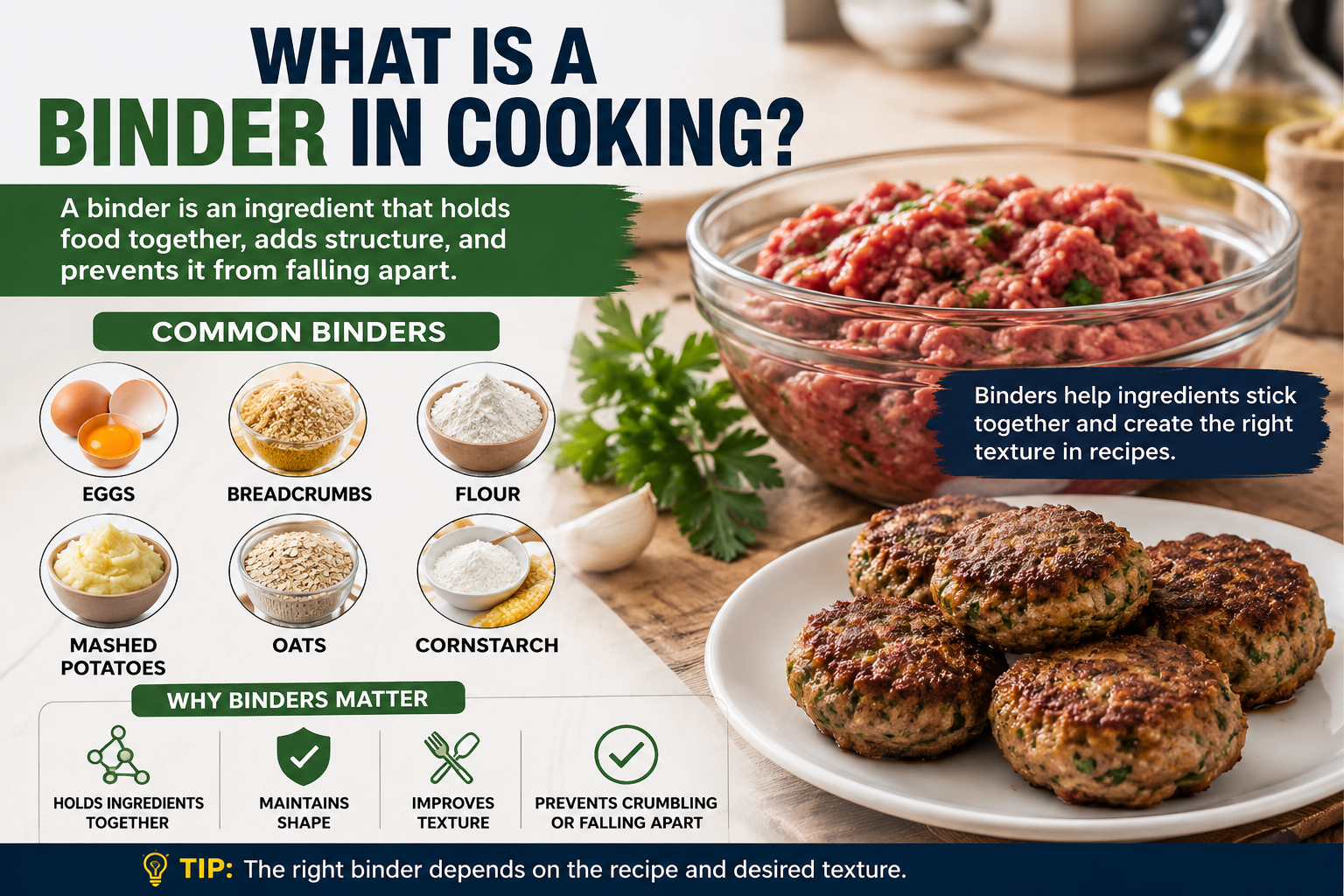
A binder is the ingredient that prevents your meatballs from crumbling, helps a casserole hold its shape, or keeps a veggie burger together in the pan. But what is a binder in cooking, and how do you choose the right one?
In simple terms, a culinary binder holds separate ingredients together, improves structure, and often controls moisture. Eggs, breadcrumbs, flour, cornstarch, oats, gelatin, and ground flaxseed are all common examples, but each works differently and produces a different texture.
Quick Answer: A binder in cooking is an ingredient that helps other ingredients stick together and form a cohesive mixture. Common binders include eggs, breadcrumbs, flour, starch, gelatin, oats, and plant-based gels.
What Does a Binder Do in Cooking?
A binder acts like edible glue. It connects loose, wet, dry, or crumbly ingredients so the finished dish maintains its intended shape and texture.
Depending on the recipe, a binder may:
- Keep meatballs, patties, or croquettes from falling apart
- Give cakes, cookies, and breads a stable structure
- Hold coatings or breadcrumbs on meat and vegetables
- Absorb excess liquid in fillings and casseroles
- Thicken sauces, gravies, soups, and pie fillings
- Create a gel in desserts, terrines, or chilled dishes
- Improve moisture retention and tenderness
Some binding agents become firm when heated, including eggs and certain starches. Others, such as gelatin and agar, form their strongest structure as the food cools.
How Do Cooking Binders Work?
Binders do not all rely on the same scientific process. Most fall into three main groups: proteins, starches, and gums or gelling agents.
Protein-Based Binding
Eggs are the most familiar protein binder. When heated, egg proteins unfold, connect, and coagulate, creating a network that holds the surrounding ingredients together.
This is why eggs can stabilize meatloaf, custard, casseroles, baked goods, and breaded coatings. Egg proteins can bind meat or fish mixtures while also contributing structure to cakes and cookies.
Other protein-based binders include:
- Gelatin
- Cheese
- Milk proteins
- Wheat gluten
- Certain plant proteins
Starch-Based Binding
Flour, cornstarch, potato starch, tapioca starch, and arrowroot bind by absorbing water. When heated in liquid, the starch granules swell and create a thicker, more cohesive mixture.
Starches are especially useful in:
- Sauces and gravies
- Pie fillings
- Soups
- Puddings
- Vegetable patties
- Gluten-free baking
The thickening or binding effect develops as starch gelatinizes during cooking. Different starches require different temperatures and may produce glossy, cloudy, firm, or delicate results.
Absorbent Binding
Breadcrumbs, oats, cracker crumbs, and cooked grains absorb moisture rather than forming a strong chemical network by themselves. They reduce looseness and help distribute liquid throughout a mixture.
These ingredients often work best when combined with eggs or another protein binder. In meatloaf, for example, breadcrumbs absorb juices while the egg helps set the mixture.
Gums and Gelling Agents
Xanthan gum, guar gum, pectin, agar, and gelatin create viscosity or a gel that restricts movement between ingredients. These binders are particularly useful in gluten-free baking, chilled desserts, jams, sauces, and commercial food preparation.
Because they are powerful, gums are normally used in much smaller quantities than flour or breadcrumbs.
Common Types of Binders in Cooking
| Binder | How It Works | Best Uses | Important Consideration |
|---|---|---|---|
| Eggs | Proteins coagulate when heated | Meatballs, meatloaf, cakes, casseroles, coatings | Too much can create a firm or rubbery texture |
| Breadcrumbs | Absorb moisture and add body | Meat mixtures, croquettes, stuffing | May require egg or liquid for stronger binding |
| Flour | Forms gluten or thickens through starch | Baking, roux, batters, sauces | Raw flour should be properly cooked |
| Cornstarch | Gelatinizes in heated liquid | Gravies, soups, puddings, pie fillings | Can lose strength if overcooked or stirred excessively |
| Oats | Absorb moisture and add structure | Meatloaf, veggie burgers, breakfast bakes | May produce a coarser texture |
| Cracker crumbs | Absorb liquid and fill gaps | Meatloaf, salmon patties, casseroles | Can add significant salt |
| Mashed potatoes | Starch creates body and cohesion | Fish cakes, croquettes, vegetable patties | Too much can make the mixture heavy |
| Ground flaxseed | Forms a gel when mixed with water | Vegan baking, patties, pancakes | Adds a mild earthy flavor |
| Chia seeds | Absorb water and create gel | Vegan baking, puddings, burgers | Whole seeds may remain visible |
| Gelatin | Forms a protein gel as it cools | Cheesecakes, mousses, terrines, desserts | Not vegetarian or vegan |
| Agar | Forms a firm plant-based gel | Vegan desserts, jellies, molded dishes | Sets more firmly than gelatin |
| Xanthan gum | Increases viscosity and stabilizes mixtures | Gluten-free baking, sauces, dressings | Excess creates a gummy texture |
| Nut butter | Adds fat, protein, and stickiness | Energy bites, cookies, snack bars | Strong flavor and allergen concerns |
| Cooked rice or quinoa | Absorbs moisture and adds bulk | Stuffed vegetables, patties, veggie burgers | Needs another binder in very loose mixtures |
The Best Binder Depends on the Recipe
There is no single ingredient that works perfectly in every dish. The right binder depends on whether you need firmness, tenderness, moisture absorption, thickening, or cold-setting structure.
Best Binders for Meatballs and Meatloaf
Eggs and breadcrumbs are commonly used together in ground-meat mixtures. The egg provides protein-based structure, while the breadcrumbs absorb moisture and help keep the finished dish tender.
A particularly effective option is a panade, which is made by soaking bread or breadcrumbs in milk, stock, or another liquid. The hydrated bread distributes moisture throughout the meat and reduces the risk of dry, dense meatballs.
For approximately 1 pound or 450 grams of ground meat, a practical starting point is:
- One small egg
- Approximately ¼ to ½ cup breadcrumbs
- Enough milk or stock to moisten the crumbs
The exact quantity should be adjusted according to the meat’s fat content and the amount of vegetables, sauce, or other liquid in the mixture.
Do Hamburgers Need a Binder?
Traditional beef burgers usually do not need eggs or breadcrumbs. Ground beef contains proteins that naturally help the patty hold together, especially when it is shaped carefully and kept cold.
Adding eggs and breadcrumbs turns the texture closer to meatloaf or meatballs. A binder may be useful in poultry burgers, vegetable-heavy patties, or mixtures containing loose ingredients, but it is usually unnecessary for a basic beef burger.
Best Binders for Veggie Burgers
Vegetable burgers often need more binding support because beans, vegetables, and cooked grains do not behave like ground meat.
Useful veggie burger binders include:
- Ground flaxseed mixed with water
- Eggs
- Mashed beans
- Mashed potatoes
- Oat flour
- Breadcrumbs
- Cooked rice
- Chickpea flour
- Chia gel
- Nut or seed butter
For the best result, combine one moisture-absorbing ingredient with one sticky or gel-forming ingredient. For example, oats can absorb excess liquid while a flax gel provides cohesion.
A vegetable burger mixture should feel slightly tacky and hold together when pressed. If it spreads or sticks heavily to your hands, it may contain too much moisture.
Best Binders for Baking
In baking, binders help create structure around air bubbles, fat, sugar, and liquid. Eggs are especially valuable because they can bind, emulsify, add moisture, and support browning at the same time.
Common baking binders include:
- Eggs
- Wheat flour and gluten
- Ground flaxseed
- Chia seeds
- Mashed banana
- Applesauce
- Yogurt
- Psyllium husk
- Xanthan gum
- Guar gum
Not every egg replacement performs every egg function. A flax egg may bind cookies successfully but will not provide the same lift or delicate structure as whipped egg whites.
The University of Minnesota Extension notes that the best egg substitute depends on the egg’s purpose in the recipe. Eggs commonly act as binders in baked goods, casseroles, burgers, and meatloaf, but they may also provide leavening, moisture, color, or richness.
Best Binders for Sauces and Fillings
When cooks describe flour or cornstarch as a binder, they may be referring to its ability to connect liquid ingredients by thickening them.
Popular options include:
- Flour: Best for roux-based gravies, béchamel, stews, and creamy sauces
- Cornstarch: Best for glossy sauces, fruit fillings, and quick gravies
- Arrowroot: Useful for clear sauces and acidic fruit mixtures
- Tapioca starch: Effective in pie fillings and gluten-free recipes
- Egg yolks: Suitable for custards, curds, and enriched sauces
- Reduction: Concentrates a sauce without adding a separate binder
Cornstarch and flour should not be added carelessly to hot liquid. Cornstarch is usually mixed with cool water to create a slurry, while flour is often cooked with fat to form a roux.
Best Binders for Breaded Foods
In breading, a binder helps the outer coating adhere to the food.
A basic breading system usually contains:
- Flour for a dry base layer
- Beaten egg, buttermilk, or batter as the wet binder
- Breadcrumbs, panko, cornmeal, or crushed cereal as the coating
Pat the food dry before breading and allow the coated item to rest briefly before frying or baking. This gives the layers time to adhere and reduces the chance of the coating falling off.
Binder vs. Thickener vs. Emulsifier
These terms overlap, but they are not always interchangeable.
| Function | Primary Purpose | Examples |
| Binder | Holds solid or semi-solid ingredients together | Egg, breadcrumbs, flaxseed, oats |
| Thickener | Increases the viscosity of a liquid | Flour, cornstarch, arrowroot |
| Emulsifier | Helps oil and water remain combined | Egg yolk, mustard, lecithin |
| Gelling agent | Forms a semi-solid network | Gelatin, agar, pectin |
| Leavening agent | Produces or traps gas to make food rise | Baking powder, yeast, whipped egg whites |
An ingredient may perform more than one function. Egg yolk can bind a mixture, thicken custard, and emulsify mayonnaise, while flour can bind baked goods and thicken gravy.
How to Choose the Right Cooking Binder
Consider five factors before selecting a binder.
1. The Desired Texture
Eggs and gelatin create a firmer set. Breadcrumbs and panades support a softer, more tender result.
For a delicate veggie patty, mashed beans or oats may be preferable to a large amount of flour, which can create a pasty texture.
2. The Amount of Moisture
Wet mixtures usually need an absorbent binder, such as breadcrumbs, oats, flour, or starch. Dry mixtures may need a binder that also provides moisture, such as eggs, yogurt, applesauce, or hydrated flaxseed.
Do not immediately add more dry ingredients to a mixture that appears loose. Resting it for 10 to 20 minutes may allow oats, crumbs, or seeds to absorb the available liquid.
3. The Cooking Method
Choose a binder that sets under the recipe’s conditions:
- Eggs and starches strengthen during heating
- Gelatin sets during cooling
- Agar must generally be heated to activate and then cooled
- Flaxseed and chia can form gels without cooking
- Xanthan gum thickens without prolonged heating
4. Dietary Requirements
For gluten-free cooking, choose certified gluten-free oats, gluten-free breadcrumbs, potato starch, cornstarch, tapioca, flaxseed, chia, psyllium, or xanthan gum.
For egg-free or vegan recipes, try:
- One tablespoon of ground flaxseed plus three tablespoons of water
- One tablespoon of chia seeds plus three tablespoons of water
- Chickpea flour mixed with water
- Mashed potato
- Bean purée
- Applesauce or mashed banana in suitable baked goods
- Agar instead of gelatin
5. Flavor and Appearance
Every binder affects the finished dish. Banana adds sweetness, chickpea flour may add an earthy taste, and dark flaxseed can create visible specks.
Cornstarch produces a relatively glossy sauce, while flour creates a more opaque finish. Agar normally sets more firmly and less flexibly than gelatin.
Practical Binder Substitutions
Egg Substitutes for Binding
To replace one egg primarily used for binding, consider:
- Flax egg: 1 tablespoon ground flaxseed plus 3 tablespoons water
- Chia egg: 1 tablespoon chia seeds plus 3 tablespoons water
- Mashed banana: Approximately ¼ cup
- Applesauce: Approximately ¼ cup
- Mashed potato: Approximately ¼ cup
- Aquafaba: Approximately 3 tablespoons
- Commercial egg replacer: Use according to package directions
Allow flaxseed or chia mixtures to sit for approximately 5 to 10 minutes before use so they can develop a gel.
Banana and applesauce work best in sweet baking. For savory dishes, flaxseed, chia, chickpea flour, mashed beans, or potatoes are usually more suitable.
Breadcrumb Substitutes
Instead of breadcrumbs, use:
- Crushed crackers
- Rolled oats
- Oat flour
- Crushed cornflakes
- Cooked rice
- Quinoa
- Almond meal
- Cornmeal
- Gluten-free breadcrumbs
- Finely crushed pretzels
Account for seasoning before adding salted crackers, pretzels, or flavored crumbs.
Cornstarch Substitutes
Cornstarch can often be replaced with:
- Arrowroot powder
- Potato starch
- Tapioca starch
- Rice flour
- All-purpose flour
- Instant clear gel
- Reduction or purée, depending on the dish
These alternatives are not always interchangeable in equal amounts. Their thickening strength, clarity, flavor, and heat tolerance can differ.
Common Binder Mistakes to Avoid
Using Too Much Binder
More binder does not always create a better structure. Excess egg can make meat mixtures rubbery, while too much flour or starch can make patties dense, gummy, or pasty.
Begin with a small amount and add more only when the mixture cannot maintain its shape.
Ignoring Moisture Balance
A binder cannot rescue an extremely watery mixture without changing its texture. Drain cooked vegetables, squeeze moisture from grated zucchini, and allow hot ingredients to cool before combining them.
Removing unnecessary liquid often produces a better result than adding large quantities of flour.
Failing to Hydrate the Binder
Dry breadcrumbs, flaxseed, chia, psyllium, and oats need time to absorb moisture. Adding them immediately before cooking may lead to uneven texture or weak binding.
After mixing, let the mixture rest before deciding whether it needs additional binder.
Overmixing Meat
Mixing ground meat aggressively develops a tight protein structure. The result may hold together well but feel tough and springy.
Mix only until the ingredients are evenly distributed, then shape the mixture gently.
Skipping a Test Portion
Before forming an entire batch of meatballs or patties, cook one small test piece. Check whether it holds together and evaluate the salt, moisture, tenderness, and seasoning.
Do not taste mixtures containing raw meat or uncooked eggs. A cooked test portion is the safer and more accurate approach.
Confusing a Filler With a Binder
Some ingredients add bulk without creating enough cohesion. Cooked vegetables, loose grains, and large pieces of cheese may contribute texture but may not hold a patty together on their own.
A successful mixture may need both a filler and a true binding component.
How to Fix a Mixture That Will Not Hold Together
When meatballs, fish cakes, croquettes, or veggie patties keep breaking, use this process:
- Check the moisture. Drain or squeeze out excess liquid.
- Mash some ingredients. A smoother portion can connect larger pieces.
- Add a small amount of binder. Try one tablespoon of crumbs, oats, flour, or starch at a time.
- Let the mixture rest. Wait 10 to 20 minutes for absorption.
- Chill before shaping. Cold mixtures are often easier to handle.
- Cook a test piece. Adjust only after observing how it behaves under heat.
- Handle it gently. Flip patties only after the first side has formed a stable crust.
If the mixture becomes too dry, add a small amount of egg, milk, stock, sauce, yogurt, oil, or vegetable purée, depending on the recipe.
Frequently Asked Questions
What Is the Most Common Binder in Cooking?
Egg is one of the most common binders because its proteins set during cooking and connect surrounding ingredients. Breadcrumbs, flour, and cornstarch are also widely used, depending on the dish.
Is Flour a Binder?
Yes. Flour can bind baked goods, batters, sauces, patties, and fillings.
Its gluten-forming proteins provide structure in wheat-based baking, while its starch thickens and connects liquid ingredients when heated.
Are Breadcrumbs a Binder?
Breadcrumbs can function as a binder by absorbing moisture and filling spaces between ingredients. However, they often provide better cohesion when combined with egg, milk, mashed vegetables, or another sticky ingredient.
Is Butter a Binder?
Butter is primarily a fat rather than a strong structural binder. It can help ingredients cling together in crumb crusts or no-bake mixtures, especially after chilling, but it does not provide the same binding strength as eggs, starches, or gels.
Is Milk a Binder?
Milk is generally a liquid and moisture source, not a binder by itself. However, it can hydrate breadcrumbs to create a panade, and its proteins may contribute some structure in baked or cooked dishes.
Is Cheese a Binder?
Melted cheese can connect ingredients as it softens and then firms during cooling. It works well in casseroles, stuffed foods, fritters, and baked dishes, although its fat may make some mixtures softer when hot.
Can I Cook Without a Binder?
Many dishes do not require an added binder. Pure beef burgers, properly prepared falafel, formed rice, and some doughs hold together through their natural proteins or starches.
The goal is not to add a binder automatically. Use one only when the recipe’s ingredients cannot create enough cohesion on their own.
Final Thoughts
Understanding what is a binder in cooking makes it easier to troubleshoot recipes rather than blindly adding more flour or eggs. The best binder is the one that provides enough structure without making the food heavy, tough, dry, or gummy.
Use eggs for protein-based structure, crumbs or oats for moisture absorption, starches for heated liquids, and flaxseed, chia, or agar for plant-based alternatives. Most importantly, add binders gradually, give them time to work, and test the mixture before cooking the entire batch.
