
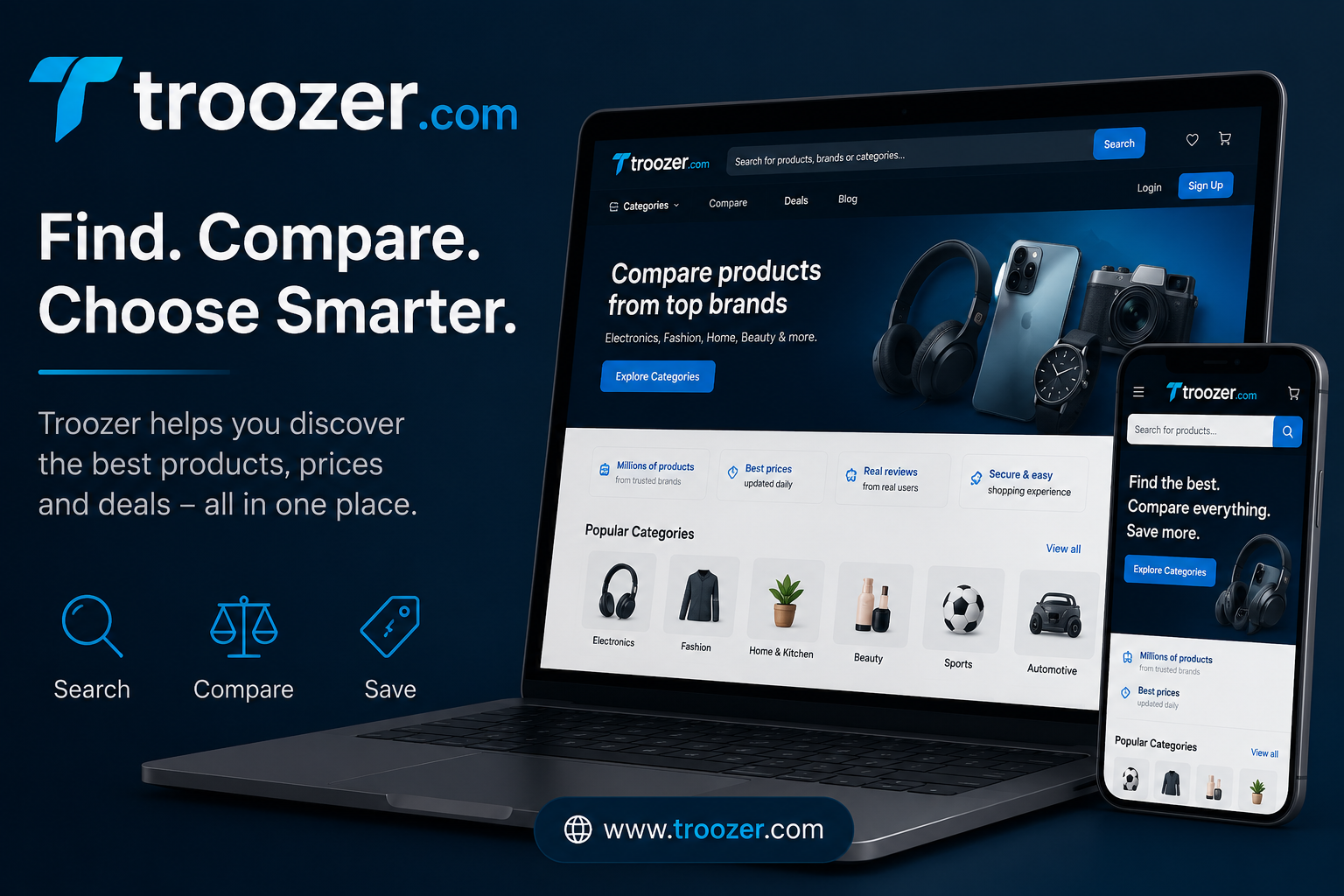
The search term troozer com usually comes from people trying to identify an unfamiliar website. They want to know what the platform does, whether its information is reliable, and whether visiting or interacting with it involves any risk.
The clearest available evidence suggests that Troozer has operated primarily as a multi-topic content website. Indexed pages associated with the domain include articles covering areas such as real estate, business, entertainment, streaming services, and general online guidance.
However, the picture becomes confusing when third-party websites describe Troozer as a shopping platform, productivity dashboard, artificial-intelligence tool, price-comparison service, or business-management system. Many of these descriptions do not match the publicly indexed pages associated with the actual domain.
This guide separates observable information from speculation so that readers can evaluate troozer com sensibly.
Quick Facts About troozer com
| Question | Practical answer |
|---|---|
| What is Troozer com? | It appears to be a multi-topic publishing or informational website |
| Is it a shopping marketplace? | No verified product catalogue or checkout system has been established |
| Is it project-management software? | No reliable evidence confirms task boards, workspaces, or collaboration tools |
| Does it publish articles? | Yes, indexed pages include general informational content |
| Is it automatically trustworthy? | No unfamiliar website should be trusted without checking its ownership, policies, and security |
| Is it a confirmed scam? | There is not enough verified evidence to make that claim |
| Should users enter sensitive information? | Only after independently verifying who operates the site and how data is handled |
What Is troozer com?
Based on publicly indexed pages, troozer com appears to have functioned as an online publishing site covering unrelated subjects rather than one narrowly defined service.
For example, one indexed article discusses using vacant land to create business opportunities. Another covers entertainment and streaming alternatives. These pages resemble standard blog posts, with titles, publication dates, categories, authors, headings, and long-form explanatory content.
That structure is consistent with a general-interest content website.
It is not, by itself, evidence of:
- A functioning ecommerce marketplace
- A private search engine
- A cloud-storage platform
- A team collaboration dashboard
- An automated business-management system
- A verified price-comparison service
Those descriptions appear frequently in third-party articles, but several sources openly acknowledge that online explanations of Troozer conflict with one another.
Why Are Descriptions of Troozer So Inconsistent?
The main difficulty with researching troozer com is not a complete lack of information. It is the amount of contradictory information.
Some articles describe it as a digital workspace. Others present it as a shopping aggregator, artificial-intelligence platform, research tool, ecommerce solution, or online magazine.
These cannot all be accepted without evidence.
Similar Articles May Be Repeating One Another
Many website-review articles use nearly identical claims, feature lists, and conclusions without demonstrating that the writer created an account, tested a dashboard, contacted the operator, or completed a transaction.
Once an unsupported description appears online, other publishers may repeat it. The repeated claim can then look credible simply because it appears on several pages.
Repetition, however, is not independent verification.
The Name Does Not Explain the Service
“Troozer” is a brand-style term rather than a descriptive phrase. It does not immediately tell users whether the site covers news, software, shopping, entertainment, or something else.
That uncertainty creates space for speculation.
The Website May Have Changed Over Time
Websites can change ownership, designs, categories, and business models. A domain that once published general articles could later be redesigned or repurposed.
Older indexed pages should therefore be treated as historical evidence of what the website contained, not a permanent guarantee of its current purpose.
Third-Party Pages May Be Targeting Search Traffic
Some articles appear designed mainly to rank for the growing keyword rather than document a genuine user experience.
Common warning signs include:
- Feature claims without screenshots
- Pricing claims without a pricing-page reference
- No named company or development team
- No explanation of how the platform was tested
- Generic pros and cons
- Descriptions that contradict the visible website
- Claims copied across unrelated publications
A trustworthy review should distinguish observed functions from assumptions.
What Does the Available Evidence Actually Show?
A useful evaluation should focus on what can be observed rather than what anonymous articles promise.
Evidence Supporting a Content-Website Description
Indexed pages from the domain show conventional editorial elements, including:
- Article headlines
- Author information
- Publication dates
- Topic categories
- Long-form text
- Internal navigation
- Images
- Informational sections
One page is categorised under real estate and discusses potential business uses for undeveloped land. Another is an entertainment-focused article about streaming alternatives.
These examples support the conclusion that Troozer has been used as a general publishing site.
Claims That Remain Unverified
The following features are commonly mentioned by third-party pages but remain insufficiently supported:
| Online claim | Evidence needed to verify it |
| Product comparison | Searchable listings, retailer sources and current prices |
| Project management | A working dashboard, task boards and user documentation |
| Cloud storage | Upload controls, storage limits and security documentation |
| Team collaboration | Invitations, permissions, comments and shared workspaces |
| Artificial-intelligence tools | A working tool, technical explanation and usage terms |
| Ecommerce functions | Seller accounts, product pages, checkout and payment policies |
| Workflow automation | Triggers, actions, integrations and help documentation |
Without those elements, such claims should not be presented as established facts.
Is troozer com Legit?
The word “legit” can refer to several different questions:
- Does the website exist?
- Does it publish real pages?
- Is the information accurate?
- Is the operator transparent?
- Is it safe to create an account?
- Is it safe to submit payment or identity information?
A site can exist and publish accessible articles without meeting every standard of transparency, editorial quality, privacy, or transactional security.
Indexed pages confirm that the domain has hosted real content. That does not automatically verify every claim made about the brand, every article published under it, or every future version of the website.
The most accurate conclusion is that troozer com appears to be a real content-based website, but its wider identity and supposed software features are not clearly verified.
Is troozer com a Scam?
There is not enough reliable evidence to label Troozer a confirmed scam.
A responsible review should not make that accusation simply because:
- The domain is unfamiliar
- Its branding is unclear
- Some articles contain generic content
- Third-party descriptions conflict
- Independent reviews are limited
At the same time, the absence of confirmed scam reports does not prove that every page, advertisement, download, or request associated with the name is safe.
The sensible position is neither automatic trust nor automatic accusation. It is limited trust until verification is complete.
How to Check troozer com Safely
Users can evaluate Troozer using the same process they should apply to any unfamiliar domain.
1. Confirm the Exact Address
Look carefully at the domain shown in the browser.
Small changes can lead to unrelated websites, including:
- Added hyphens
- Alternative extensions
- Misspelled words
- Extra subdomains
- Lookalike characters
A page discussing “Troozer” may not be operated by the owner of the exact domain the reader intended to visit.
2. Check the Site’s Purpose
A legitimate website should make its main function understandable.
Look at:
- The homepage headline
- Main navigation
- About page
- Categories
- Product or service pages
- Account area
- Help documentation
When the homepage behaves like a blog, it should not be assumed to provide enterprise software merely because another article says it does.
3. Look for Ownership Information
Check whether the site identifies:
- The business or publisher
- Editorial leadership
- A physical or registered location
- A working contact method
- Named authors
- Company registration information, when relevant
Missing information does not prove fraud, but it reduces accountability.
4. Read the Privacy Policy
Before subscribing, creating an account, or completing a form, determine what information is collected.
A useful privacy policy should explain:
- What data is gathered
- Why it is collected
- Which third parties receive it
- How cookies are used
- How long information is retained
- How users can request deletion
- How to contact the data controller
Avoid entering sensitive information when these points are missing or vague.
5. Review the Terms and Conditions
Terms should clarify the relationship between the website and its visitors.
For a content site, the terms may cover copyrights, disclaimers, user comments, external links, and limitations of liability.
For a commercial platform, they should also explain payments, cancellations, refunds, account suspension, disputes, and customer responsibilities.
6. Test Contact Information
A displayed email address is not automatically proof of genuine support.
Send a basic, non-sensitive question and assess:
- Whether the address works
- Whether the answer addresses the question
- Whether the sender identifies the business
- Whether the response pressures you to pay
- Whether you are asked for unnecessary personal details
Do not send identity documents merely to test support.
7. Inspect External Links
General publishing websites often link to other platforms, advertisers, or affiliate partners.
Before following a link:
- Check the destination domain
- Avoid unexpected downloads
- Do not approve browser notifications without a reason
- Do not reuse an important password
- Close pages that imitate security alerts
- Verify products directly with the named retailer
A secure connection only protects data during transmission. It does not guarantee that the content or operator is trustworthy.
How to Evaluate Articles Published on Troozer
Even when a website is safe to open, its information should still be assessed critically.
Check the Author
A trustworthy article should ideally identify who wrote it and why that person is qualified to discuss the subject.
For low-risk lifestyle topics, formal credentials may not be necessary. For legal, medical, financial, or cybersecurity guidance, expertise and source quality matter much more.
Check the Publication Date
Old guidance can become inaccurate.
This is especially important for:
- Prices
- Tax rules
- Software instructions
- Laws
- Streaming availability
- Privacy practices
- Product specifications
- Financial information
An article may remain indexed long after its details have changed.
Follow the Original Source
When a post mentions a study, regulation, product feature, warning, or company policy, open the original source where possible.
A publisher summarising another publisher is less reliable than:
- Official documentation
- Government guidance
- A primary research paper
- The company’s own policy
- Direct product documentation
Watch for Unsupported Certainty
Be cautious with phrases such as:
- “Completely safe”
- “Guaranteed results”
- “Officially approved”
- “Best for everyone”
- “Risk-free”
- “100% accurate”
Strong conclusions require strong evidence.
Potential Advantages of troozer com
If used as a general reading platform, Troozer may offer several practical benefits.
Broad Topic Coverage
Readers may find articles across multiple categories without visiting a separate specialist website for every basic question.
Scannable Content
List-style articles, short sections, and descriptive headings can make introductory information easy to review.
Free Access to General Information
Public blog content can usually be read without purchasing software or committing to a paid subscription.
Discovery of New Topics
A multi-category format can help readers encounter ideas outside their usual interests.
These benefits relate to Troozer as a publishing website, not to the unverified productivity or shopping features attributed to it elsewhere.
Possible Limitations and Risks
Unclear Brand Positioning
Visitors may struggle to determine what Troozer specialises in or why they should consider it authoritative.
Mixed Subject Expertise
A website covering many unrelated industries may not have deep expertise in every category.
Potentially Outdated Articles
Older content may remain searchable even after services, prices, laws, or recommendations change.
Limited Independent Verification
Claims about the website itself are often repeated by low-authority third-party blogs rather than established technology reviewers.
Confusion Between Similar Domains
Users searching the brand may encounter unrelated websites using similar names or variations.
Unverified Feature Claims
Descriptions of dashboards, automation, cloud storage, ecommerce, or price comparison should not be trusted without direct evidence.
Troozer Compared With a Clearly Defined Platform
| Evaluation area | Clearly defined platform | Troozer’s visible position |
| Main purpose | Immediately explained | Often interpreted differently |
| Product documentation | Detailed and accessible | Not clearly established |
| Feature demonstrations | Screenshots, demos or trials | Wider software claims remain unverified |
| Ownership | Named company and team | Should be independently checked |
| Pricing | Public plans and billing terms | No consistently verified service pricing |
| User reviews | Available across independent sources | Limited dependable user evidence |
| Indexed content | Supports the stated service | Supports a general publishing role |
The biggest issue is not necessarily that Troozer provides a bad service. It is that many supposed services are difficult to confirm.
Who May Find Troozer Useful?
Troozer may be useful for readers who:
- Want introductory articles on broad topics
- Understand that blog content requires verification
- Are browsing without entering personal information
- Compare advice with stronger primary sources
- Treat old pages as potentially outdated
- Want general ideas rather than professional guidance
It is less suitable for users seeking:
- Verified professional advice
- Confidential file storage
- Business-critical project management
- High-value financial transactions
- Evidence-based medical recommendations
- A proven ecommerce marketplace
- Software with dependable customer support
Until specific services are independently confirmed, users should not rely on the site for high-stakes tasks.
Common Mistakes to Avoid
Believing Every Search Result
A page ranking highly for troozer com does not necessarily have a relationship with Troozer or direct knowledge of its operations.
Confusing Commentary With Evidence
An article saying the platform includes artificial intelligence, automation, or shopping tools is not proof that those tools exist.
Assuming HTTPS Means the Business Is Verified
HTTPS encrypts the connection. It does not certify the accuracy of the content, the identity of the operator, or the fairness of a transaction.
Reusing an Important Password
Never use the same password across unfamiliar sites, email accounts, banking services, or social platforms.
Entering Payment Details Too Quickly
Before paying, verify the merchant name, refund terms, support details, checkout provider, and exact product being purchased.
Treating General Content as Professional Advice
Blog posts can provide starting points, but important financial, legal, health, and security decisions require qualified and current sources.
Final Verdict on troozer com
The most defensible description of troozer com is that it has operated as a broad informational or publishing website. Publicly indexed pages support that conclusion, while claims that it is an all-in-one productivity suite, private search engine, ecommerce platform, cloud workspace, or shopping-comparison service remain insufficiently verified.
There is also not enough dependable evidence to call the website a confirmed scam. The appropriate approach is cautious evaluation: read public content without automatically trusting it, verify important claims through primary sources, and avoid submitting sensitive data until the operator, policies, and purpose are clear.
For readers asking what troozer com really is, the answer is simpler than many competing articles suggest: it appears to be a general content site surrounded by considerable online speculation. Judge it by what can be directly observed, not by unsupported lists of features repeated across the web.
