
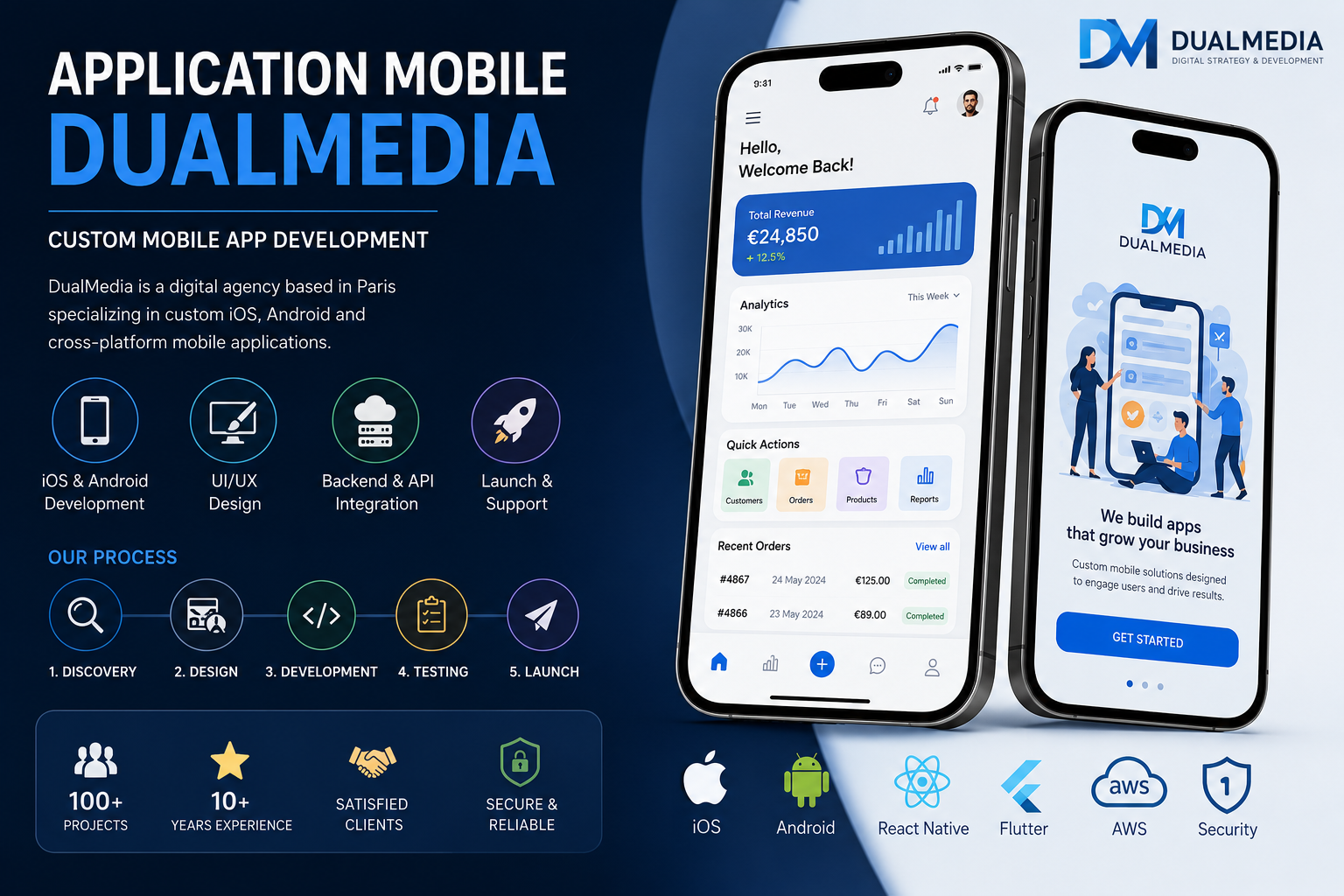
The phrase application mobile DualMedia generally refers to custom mobile application development services offered by DualMedia, a Paris-based digital agency specializing in iOS, Android, web, UX, and digital strategy.
It should not be confused with a downloadable consumer app named “DualMedia.” In its official context, DualMedia is a development agency that helps startups, businesses, retailers, media companies, and other organizations create mobile products tailored to their goals.
This guide explains what the service includes, how the development process works, what a project may cost, and which questions you should answer before requesting a quote.
Application Mobile DualMedia: Quick Facts
| Detail | Overview |
|---|---|
| Search intent | Commercial investigation and development guide |
| Main service | Custom iOS and Android application development |
| Available approaches | Native, cross-platform, MVP, and business applications |
| Suitable for | Startups, SMEs, enterprises, retailers, media, and service businesses |
| Entry-level budget | Approximately €8,000 for a simple showcase app |
| Typical MVP timeline | Around 8–16 weeks |
| Complex project timeline | Up to 8–18 months |
| Post-launch services | Maintenance, updates, store publishing, and ASO |
The budget and timeline figures above are indicative ranges published by DualMedia. The final quote depends on features, design, integrations, platforms, security requirements, and project scope.
What Is Application Mobile DualMedia?
Application mobile DualMedia is best understood as a custom mobile development service rather than a ready-made application.
A client brings an idea, business problem, existing platform, or product brief. The agency then helps transform that concept into a working iPhone, Android, or cross-platform application.
The service may include:
- Product discovery and project scoping
- User research and journey mapping
- UX and interface design
- Native or cross-platform development
- Backend and API integration
- Payment, mapping, chat, or authentication features
- Quality assurance and user testing
- App Store and Google Play submission
- App Store Optimization
- Maintenance and future updates
DualMedia’s official service pages describe custom development for startups, SMEs, and larger organizations rather than a standardized software product sold to every customer.
Who Should Consider a DualMedia Mobile Application?
A custom application makes sense when a mobile website cannot deliver the required experience, speed, personalization, device access, or offline functionality.
Startups Validating an Idea
A startup can use an MVP, or Minimum Viable Product, to test its main idea without funding every possible feature.
The first version should solve one important problem exceptionally well. User feedback can then guide later improvements instead of relying on assumptions.
DualMedia positions its startup service around MVP scoping, UX design, development, testing, and publication on the App Store and Google Play.
Businesses Managing Internal Operations
A business application can replace spreadsheets, emails, paper forms, and disconnected tools.
Common internal uses include:
- Field-service reporting
- Inventory management
- Employee scheduling
- Sales tracking
- Document approval
- Inspection checklists
- Customer relationship management
- Delivery or intervention tracking
The strongest business apps are not digital copies of inefficient processes. They simplify the process before turning it into software.
Retail and E-Commerce Brands
Retail applications can provide more direct and personalized customer experiences than standard websites.
Useful functions may include:
- Product catalogs
- Mobile checkout
- Customer accounts
- Loyalty programs
- Digital membership cards
- Click and collect
- Personalized recommendations
- Order tracking
- Location-based store information
Media, Publishing, and Event Companies
Media organizations may need content feeds, subscriptions, streaming, saved content, alerts, or digital editions.
Event applications can combine schedules, venue maps, ticket information, speaker profiles, real-time updates, and push notifications in one interface.
DualMedia identifies media, events, retail, photography, production, e-commerce, marketplaces, and B2B operations among the project categories it supports.
Core Features of a Modern Mobile Application
The correct feature set depends on the problem the application is designed to solve. Adding functionality without evidence of user demand increases cost and makes the product harder to navigate.
Secure User Accounts
Account functionality can include:
- Email registration
- Social sign-in
- Multi-factor authentication
- Password recovery
- User roles
- Profile management
- Biometric login
Authentication should be designed around actual risk. A simple content app does not need the same controls as a healthcare, financial, or enterprise application.
Push Notifications
Push notifications can improve retention when they deliver relevant information at the right time.
They become harmful when every promotion, update, or minor event triggers an alert. Users should be able to control notification categories and frequency.
Payments and Subscriptions
An application may support:
- One-time purchases
- Recurring subscriptions
- Marketplace transactions
- Digital wallets
- Apple Pay or Google Pay
- Refund management
- Invoice generation
Payment features also require careful handling of taxes, security, platform rules, failed transactions, and subscription cancellation.
Geolocation and Mapping
Location features are useful for delivery services, transport, tourism, field operations, property platforms, and local marketplaces.
Location access should only be requested when the benefit is clear. Asking for permanent access without a genuine need can reduce trust.
Real-Time Messaging
Chat functionality may include direct messages, customer support, group conversations, image sharing, delivery status, or automated assistance.
Real-time systems add backend complexity. Moderation, spam prevention, data retention, blocking, and notification logic should be planned before development begins.
Administrative Dashboard
Many mobile applications need a web-based back office where authorized staff can:
- Manage users
- Edit content
- Review orders
- Send notifications
- Handle reports
- View analytics
- Control permissions
- Export data
Ignoring the administration interface is a common planning mistake. The customer-facing app cannot operate efficiently if the internal team has no practical way to manage it.
Native vs Cross-Platform Development
Choosing the development approach is one of the most important technical decisions in an application mobile DualMedia project.
| Approach | Best suited to | Main advantage | Main limitation |
| Native iOS | Apple-focused products | Maximum iOS performance and integration | Separate Android development required |
| Native Android | Android-first products | Full access to Android capabilities | Separate iOS development required |
| Cross-platform | Standard apps targeting both platforms | Shared codebase and controlled budget | Some advanced functions may need native code |
| PWA | Content, forms, portals, and smaller budgets | No traditional app-store installation required | Limited access to certain device features |
Choose Native Development When:
- Advanced camera or sensor access is essential
- Graphics and animation performance are critical
- The product relies heavily on platform-specific features
- Background processing is complex
- Separate platform experiences are strategically important
Swift is commonly used for native iOS development, while Kotlin is a leading choice for native Android projects.
Choose Cross-Platform Development When:
- The same experience is required on iOS and Android
- Launch speed is important
- The budget cannot support two independent codebases
- Features are relatively standard
- Long-term maintenance efficiency matters
DualMedia identifies React Native and Flutter as cross-platform options and states that native development remains preferable for demanding graphics, real-time features, or extensive hardware access.
Application Mobile DualMedia Development Process
A reliable mobile project should move through clearly defined stages.
1. Discovery and Product Scoping
The first stage defines what the application must accomplish.
The team should identify:
- Target users
- Primary user problem
- Business objective
- Core value proposition
- Required platforms
- Essential features
- Technical constraints
- Revenue model
- Budget range
- Success metrics
A vague request such as “build an app like a major marketplace” is not a usable specification. The idea must be translated into realistic user journeys and measurable requirements.
2. MVP Prioritization
Every proposed feature should be classified as:
- Essential for launch
- Valuable but not essential
- Suitable for a later version
- Unnecessary until demand is proven
A useful MVP is not an incomplete or low-quality product. It is a focused product with the smallest feature set required to solve the core problem.
3. UX and Interface Design
Design begins with structure, not decorative colors.
The design process may include:
- User flows
- Information architecture
- Low-fidelity wireframes
- Interactive prototypes
- User testing
- High-fidelity visual design
- Developer-ready design specifications
Testing the prototype before writing production code makes navigation problems cheaper to correct.
4. Technical Architecture
The team selects the frontend framework, backend technology, database, hosting environment, integrations, analytics tools, and security controls.
Architecture decisions should consider:
- Expected user volume
- Data sensitivity
- Offline requirements
- Real-time activity
- Scalability
- Existing business systems
- Maintenance resources
- Regulatory obligations
The best technology is not automatically the newest option. It is the option that fits the product, team, budget, and expected lifespan.
5. Development in Iterations
Modern application development is usually divided into short iterations or sprints.
Each cycle should produce something reviewable, such as a login journey, payment flow, dashboard, or messaging feature. Regular demonstrations reduce the risk of discovering major misunderstandings at the end.
DualMedia states that its projects may be organized in two-week sprints with regular demonstrations.
6. Testing and Quality Assurance
Testing should cover more than whether buttons work.
A professional quality process includes:
- Functional testing
- Device compatibility testing
- Performance testing
- Network interruption testing
- Security testing
- Accessibility reviews
- Payment testing
- Notification testing
- User acceptance testing
- App-store compliance checks
Testing on real low-end and older devices is especially important. A product that performs well only on the development team’s newest phones is not ready for a broad audience.
7. Store Publication and Launch
Publication requires store accounts, screenshots, descriptions, privacy details, category selection, icons, age ratings, and review compliance.
The launch plan should also define:
- Analytics events
- Crash monitoring
- Customer support
- Review management
- Onboarding messages
- Acquisition channels
- Update procedures
- Emergency rollback plans
DualMedia says its services can include App Store and Google Play publication, listing preparation, and ASO support.
How Much Does Application Mobile DualMedia Cost?
DualMedia publishes broad 2026 estimates ranging from approximately €8,000 for a simple showcase application to more than €200,000 for a complex platform.
| Project type | Indicative development budget | Typical timeline | Estimated annual maintenance |
| Showcase app or simple MVP | €8,000–€25,000 | 2–4 months | €1,200–€5,000 |
| Business or e-commerce app | €25,000–€70,000 | 4–8 months | €5,000–€20,000 |
| Complex platform | €70,000–€200,000+ | 8–18 months | €20,000+ |
These are guidance ranges published by the agency, not guaranteed quotes. A complex application involving finance, healthcare, artificial intelligence, marketplaces, or enterprise integrations can exceed the upper estimate.
What Determines the Final Price?
Number and Complexity of Features
A content feed is simpler than a real-time marketplace with payments, messaging, geolocation, user verification, and automated recommendations.
Each feature also creates testing, security, design, backend, and maintenance work.
Number of Platforms
Developing only for iOS or only for Android may cost less initially.
Supporting both platforms through separate native codebases usually requires more work than using a shared cross-platform framework.
Custom UX and Design
Template-based screens may reduce design costs, but they can also make the product feel generic or fail to support specialized workflows.
Custom UX becomes especially valuable when the application contains complex tasks, different user roles, or unfamiliar interactions.
Backend and Integrations
The visible mobile interface may represent only part of the project.
Costs can increase when the app must connect with:
- Payment providers
- CRM platforms
- ERP systems
- Existing websites
- Logistics providers
- Mapping services
- Artificial intelligence APIs
- Identity verification tools
- Analytics platforms
- Legacy databases
Security and Compliance
Applications handling sensitive personal, financial, medical, or employee information require stronger security controls.
The budget may need to cover encryption, access logging, penetration testing, consent management, secure hosting, backup procedures, and compliance reviews.
Maintenance
The launch is not the end of development.
Operating systems change, devices evolve, security issues appear, APIs are updated, and users request improvements. DualMedia estimates ongoing maintenance at approximately 10%–20% of the original development budget per year for many projects.
How to Reduce Development Costs Without Damaging Quality
Start With Three to Five Core Features
Identify the smallest group of features that allows users to receive the main benefit.
Everything else should require evidence before it enters the first release.
Reuse Existing Infrastructure
An existing website backend, product database, customer system, or authentication service may be reusable through an API.
Reuse should be based on technical quality, not convenience. Connecting a new application to an unstable legacy system can create more cost than replacing it.
Use Cross-Platform Development Strategically
Cross-platform frameworks can reduce duplicated work when iOS and Android require similar experiences.
Do not choose cross-platform purely because it sounds cheaper. Confirm that it can support the application’s performance, device access, security, and future roadmap.
Prepare Content Early
Missing product descriptions, policies, images, translations, and onboarding copy frequently delay launches.
Assign content ownership before development reaches its final stages.
Separate Essential Integrations From Future Integrations
Connecting five external systems during the first release can create unnecessary risk.
Start with the integrations required to deliver the primary service. Add supporting systems after the core journey is stable.
Questions to Ask Before Hiring DualMedia or Another Agency
A professional agency should be able to answer these questions clearly:
- Who owns the source code after payment?
- Which features are included in the quote?
- Which items are explicitly excluded?
- Will the app use native or cross-platform technology?
- How will design decisions be tested?
- Who manages the backend and hosting?
- How are changes to the original scope priced?
- Which security tests are included?
- Who handles App Store and Google Play submission?
- What happens if an app-store review rejects the application?
- Is post-launch maintenance included?
- How quickly are critical bugs handled?
- Will technical documentation be delivered?
- Can an internal team take over the project later?
- Which analytics and crash-reporting tools will be installed?
DualMedia states that its agency projects can include source-code ownership, technical documentation, user testing, GDPR support, fixed project commitments, and post-launch maintenance options. These points should still appear explicitly in the signed contract.
Common Mobile App Development Mistakes
Building Too Many Features Before Launch
A large feature list can make stakeholders feel that the product is ambitious.
In practice, it increases cost, delays user feedback, and makes the application harder to explain.
Copying a Competitor Without Understanding Users
A competitor’s features reflect its audience, business model, technical history, and internal resources.
Use competing products for research, but design the application around your own user problem.
Ignoring the Back Office
Employees need practical tools for managing users, orders, content, reports, and support requests.
A polished app with a weak administration system creates expensive manual work.
Treating Security as a Final Checklist
Security decisions affect architecture, permissions, data storage, integrations, and user flows.
Addressing them after development is usually slower and more expensive.
Launching Without Analytics
Downloads alone do not explain whether the product is useful.
Track meaningful events such as:
- Onboarding completion
- Account creation
- Search usage
- Purchase completion
- Subscription cancellation
- Feature adoption
- Retention
- Error frequency
Forgetting User Acquisition
A technically excellent app does not automatically attract users.
The budget should include landing pages, content, ASO, advertising, partnerships, customer communication, and review generation where appropriate.
Advantages and Limitations
| Advantages | Potential limitations |
| Custom product built around business needs | Higher cost than no-code templates |
| iOS, Android, and cross-platform options | Complex projects require long timelines |
| Support from design through publication | Final quality depends on a clear brief |
| Possibility of ongoing maintenance | Scope changes can increase the budget |
| Suitable for MVPs and enterprise systems | Custom software requires continuous ownership |
| Store launch and ASO support available | Not every business genuinely needs an app |
Is Application Mobile DualMedia the Right Choice?
A custom mobile project may be suitable when:
- Mobile usage is central to the service
- Users need regular access
- Push notifications provide genuine value
- Device capabilities are required
- A website cannot support the necessary workflow
- The business has a realistic maintenance budget
- The product has clear success metrics
- The team can support marketing and customer service
A responsive website or Progressive Web App may be more appropriate when:
- The budget is below the cost of a sustainable native application
- Users will access the service infrequently
- Search-engine visibility matters more than app-store presence
- Device-specific capabilities are unnecessary
- The concept has not yet been validated
- The main experience consists of content, forms, or simple account access
Choosing not to build an app can be a strong product decision. The goal is to solve the business problem, not merely to appear innovative.
Frequently Asked Questions
Is Application Mobile DualMedia a Downloadable App?
The official DualMedia context points to a mobile development agency and its custom services, not a single standardized consumer application. Clients commission an application based on their own requirements.
Does DualMedia Develop for iPhone and Android?
Yes. The agency advertises iOS, Android, native, and cross-platform mobile development services.
How Much Does a DualMedia Mobile Application Cost?
Published estimates begin at around €8,000 for a simple showcase application or basic MVP. Business apps may fall between €25,000 and €70,000, while complex platforms can exceed €200,000.
How Long Does Development Take?
A straightforward MVP may require approximately 8–16 weeks. A business application may take four to eight months, while a complex platform can require eight to eighteen months.
Does the Service Include App-Store Publication?
DualMedia states that it can support publication on the Apple App Store and Google Play, including store listings and ASO preparation.
Should a Startup Build a Complete App or an MVP?
Most startups should begin with a focused MVP unless regulatory, contractual, or technical requirements demand a larger first release.
The MVP should contain enough value to test real behavior—not merely enough screens to demonstrate an idea.
What Should Be Included in a Project Brief?
A useful brief should include the business objective, target users, core problem, required platforms, essential features, example user journeys, integrations, budget range, preferred launch date, and success metrics.
Conclusion
An application mobile DualMedia project is a custom software engagement that can cover strategy, UX design, iOS and Android development, backend integration, testing, store publication, and long-term maintenance.
The strongest results come from defining the user problem before selecting features. Begin with a focused scope, test the experience early, clarify ownership and maintenance terms, and request a transparent quote divided by features and delivery stages.
Approached this way, application mobile DualMedia development becomes more than a technical purchase. It becomes a structured investment in a mobile product designed to solve a measurable business problem.
