
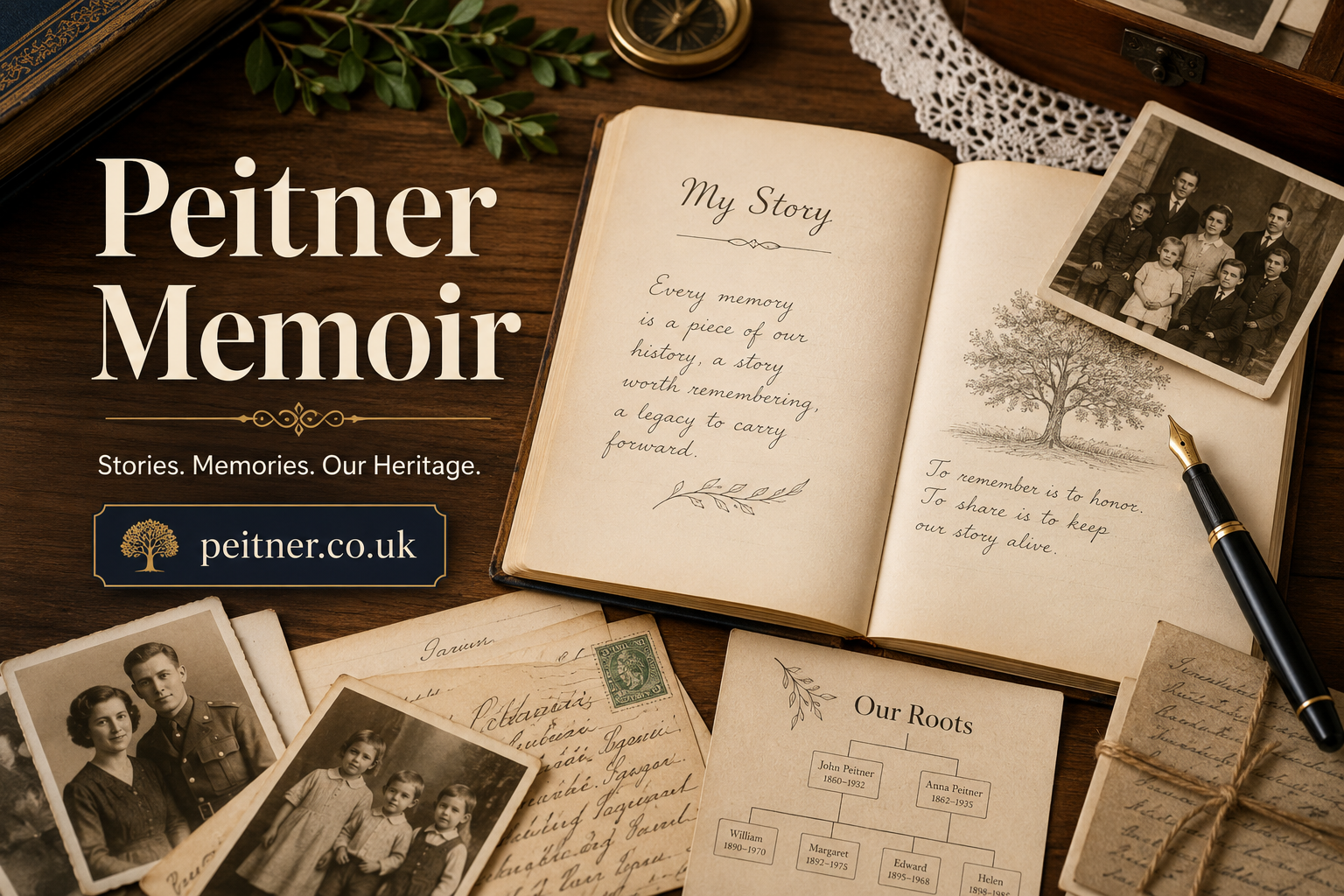
A Peitner Memoir is more than a collection of names, dates, and old photographs. It is a carefully preserved account of the people, experiences, traditions, migrations, struggles, and achievements connected with the Peitner family name.
The phrase does not currently point to one universally recognized published autobiography. Instead, it is best understood as a family-history memoir: a personal narrative that combines verified genealogical evidence with memories passed down through generations.
This guide explains what a Peitner Memoir can include, how to research it responsibly, and how to transform scattered family information into a meaningful story.
Peitner Memoir Quick Facts
| Topic | Details |
|---|---|
| Primary focus | Peitner family history and personal memories |
| Content type | Memoir, genealogy project, or family archive |
| Best sources | Interviews, certificates, photographs, census records, letters, and immigration files |
| Writing style | Personal, chronological, thematic, or biographical |
| Main purpose | Preserve identity, experiences, and family knowledge |
| Ideal formats | Printed book, private PDF, website, video, or audio archive |
| Biggest challenge | Separating documented facts from family legends |
What Is a Peitner Memoir?
A Peitner Memoir is a nonfiction narrative built around an individual, household, or family line carrying the Peitner surname. Unlike a traditional family tree, it explains what people experienced rather than simply showing how they were related.
A genealogy chart might record that an ancestor was born in a particular town and moved to another country. A memoir explores why that person left, what the journey involved, how the family adapted, and which values survived the transition.
The strongest memoirs combine three elements:
- Documented historical facts
- Firsthand or inherited memories
- Thoughtful interpretation of family experiences
This combination gives readers both accuracy and emotional depth.
Is Peitner Memoir the Title of a Published Book?
There does not appear to be one prominent, widely recognized publication officially known as Peitner Memoir. The phrase may therefore refer to a private family manuscript, an unpublished biography, a digital genealogy project, or someone searching for stories connected with the surname.
Readers should be cautious when an unfamiliar website presents the phrase as the title of a famous book without identifying an author, publisher, publication date, or ISBN.
Before accepting a publication claim, check:
- The author’s full name
- The publisher or archive
- The original publication date
- Library catalogue records
- An ISBN or permanent archive reference
- Independent reviews or citations
These details help distinguish an authentic publication from automatically generated or unsupported information.
Understanding the Peitner Family Name
Peitner appears as an uncommon surname in genealogy databases rather than a widely used ordinary word. Ancestry currently lists historical census, immigration, military, birth, marriage, and death records associated with the name, although database totals should not be treated as a complete count of every Peitner family.
Researchers may also encounter similar spellings, particularly Peintner. Geneanet records Peintner across locations in Germany and Austria, demonstrating why variant spellings can be important during family-history research.
However, similar spelling does not automatically prove that two families share the same ancestry. The connection must be established through records.
Why Surname Spellings Change
Family names often appear differently across historical documents because of:
- Regional pronunciation
- Handwritten record errors
- Translation between languages
- Clerical spelling choices
- Migration and naturalization
- Simplification by later generations
- Difficulty reading damaged documents
A person recorded as Peitner in one source might appear under a slightly different spelling elsewhere.
Useful search variations may include:
- Peitner
- Peintner
- Paintner
- Pettner
- Pittner
These should be treated as research possibilities, not confirmed equivalents.
What Makes a Peitner Memoir Different From Genealogy?
Genealogy and memoir overlap, but they serve different purposes.
Genealogy Establishes Relationships
Genealogy focuses on evidence. It identifies parents, children, marriages, residences, occupations, and major life dates.
Its central question is:
Who was related to whom?
Memoir Explains Human Experience
A memoir focuses on perspective and meaning. It describes relationships, decisions, fears, ambitions, conflicts, and turning points.
Its central question is:
What did these experiences mean to the people who lived through them?
Family History Connects Both
A complete Peitner family history can use genealogical records as its factual foundation while using memoir techniques to make the information readable and memorable.
| Genealogy Record | Memoir Opportunity |
| Birth certificate | Describe the family and community into which the person was born |
| Passenger list | Reconstruct the migration journey and its likely challenges |
| Marriage record | Explain how the couple met and built a household |
| Military record | Explore service, separation, fear, and its effect on the family |
| Census entry | Describe the home, occupation, neighbors, and economic conditions |
| Photograph | Identify the people, setting, occasion, and story behind the image |
How to Research a Peitner Memoir
A reliable memoir begins with evidence. Memory adds personality, but documentation helps prevent assumptions from becoming accepted as facts.
1. Begin With Living Family Members
Interview the oldest available relatives first. They may remember people, locations, nicknames, customs, and events that were never written down.
Ask open-ended questions such as:
- What is your earliest family memory?
- Which relatives influenced you most?
- Where did your parents and grandparents live?
- What work did family members perform?
- Were there major moves or migrations?
- Which traditions were important at home?
- What difficult periods did the family experience?
- Which stories were repeatedly told at gatherings?
- Are there subjects the family avoided discussing?
- Which photographs or possessions carry special meaning?
Record interviews with permission and keep the original files. Written notes alone may lose tone, pauses, pronunciation, and emotional detail.
2. Collect Home Archives
Before paying for databases, examine records already held by the family.
Useful materials include:
- Birth and marriage certificates
- Funeral cards and obituaries
- Passports and identity papers
- Letters and postcards
- Diaries and notebooks
- Family Bibles
- School documents
- Employment records
- Military papers
- Property documents
- Recipe books
- Photo albums
- Newspaper cuttings
- Audio or video recordings
Photograph or scan each item and record who supplied it.
3. Build a Research Timeline
Create one chronological list for every important person. Add confirmed dates first, followed by estimated events and unanswered questions.
A simple timeline might include:
| Date | Event | Location | Source | Confidence |
| 1912 | Birth | Unknown | Family recollection | Low |
| 1934 | Marriage | Confirmed town | Marriage certificate | High |
| 1948 | Migration | Port city | Passenger record | High |
| 1951 | New occupation | New country | Census record | Medium |
This method reveals contradictions before they enter the final manuscript.
4. Search Multiple Record Types
One document rarely tells the complete story. Compare information across several independent sources.
Potential records include:
- Civil registration files
- Church registers
- Census returns
- Passenger lists
- Naturalization documents
- Military service files
- Land and property records
- Probate documents
- Newspaper archives
- Cemetery registers
- School and employment records
A name and birth year matching your ancestor is not enough. Confirm relationships, locations, occupations, and other identifying details.
5. Investigate Historical Context
Family events become more understandable when placed within their time.
Research the conditions surrounding:
- Migration
- War or military service
- Economic hardship
- Industrial change
- Religious communities
- Language policies
- Border changes
- Local occupations
- Education
- Public-health crises
Historical context should support the family narrative rather than overwhelm it.
How to Verify Information Before Publishing
Family stories can preserve genuine experiences, but details often change as they are retold. A trustworthy Peitner Memoir clearly separates evidence from recollection.
Use Confidence Labels
Classify important claims as:
- Confirmed: Supported by strong primary documentation
- Probable: Supported by several matching clues
- Possible: Plausible but not yet verified
- Oral history: Remembered or inherited through family storytelling
- Disputed: Sources provide conflicting information
These labels allow uncertainty without removing meaningful stories.
Prefer Original Records
Whenever possible, consult the original certificate, register, letter, photograph, or official image rather than relying entirely on someone else’s family tree.
Online trees can provide valuable leads, but they may repeat errors copied from earlier profiles.
Keep a Source Log
For every important fact, record:
- Name of the document
- Archive or website
- Collection title
- Record date
- Page or image number
- Date accessed
- Notes about interpretation
A detailed source log makes future corrections much easier.
Choosing the Best Structure
There is no single correct format for a Peitner Memoir. The best structure depends on how much evidence exists and whose story is being told.
Chronological Structure
This approach begins with the earliest known generation and moves forward through time.
It works well when the family has:
- A clear historical timeline
- Several generations of records
- Important migrations
- Major social or economic transitions
The risk is that the narrative can become a list of dates. Each chapter should therefore focus on a meaningful change or conflict.
Single-Person Biography
This format follows one central Peitner ancestor or living family member.
Possible chapters include:
- Childhood and parents
- Education and early ambitions
- Work and adulthood
- Marriage and family life
- Migration or major change
- Hardship and resilience
- Later years
- Influence on future generations
This structure creates a focused, emotionally engaging story.
Thematic Structure
A thematic memoir organizes material around subjects rather than dates.
Themes might include:
- Work and craftsmanship
- Faith and community
- Migration and belonging
- Food and family traditions
- Education and opportunity
- War and separation
- Women in the family
- Homes and landscapes
- Letters across generations
- Reinvention in a new country
This approach is useful when historical records are incomplete.
Multi-Voice Structure
A multi-voice memoir includes memories from several relatives. Different accounts can appear side by side, especially when people remember the same event differently.
The writer should not force every memory into one version. Contradictions can reveal how age, personality, relationships, and emotion shape recollection.
A Practical Chapter Outline
A well-organized Peitner Memoir could follow this structure:
Chapter 1: The Name and the Search
Explain why the project began, what was initially known, and which questions motivated the research.
Chapter 2: The Earliest Confirmed Generation
Introduce the oldest relatives supported by reliable records. Describe their location, household, occupation, and community.
Chapter 3: Home and Daily Life
Reconstruct housing, food, education, work, religion, language, and family responsibilities.
Chapter 4: A Turning Point
Focus on an event that changed the family’s direction, such as migration, marriage, war, financial loss, or a career opportunity.
Chapter 5: Movement and Adaptation
Describe the process of entering a new town, region, or country. Explore which customs changed and which remained.
Chapter 6: The Family Remembered
Present interviews, sayings, habits, recipes, photographs, and personal memories.
Chapter 7: Gaps and Unanswered Questions
Acknowledge missing records, disputed stories, unidentified photographs, and uncertain relationships.
Chapter 8: The Peitner Legacy
Explain what later generations inherited through values, traditions, work, relationships, and identity.
How to Write With Emotional Depth
Documents establish what happened, but carefully selected details help readers imagine the experience.
Instead of writing:
The family moved in 1948.
Write:
The passenger record places the family at the port in 1948. According to later recollections, they carried only essential clothing, several photographs, and the address of a relative they had never met.
The second version remains cautious while adding human meaning.
Use Specific Details
Include details such as:
- The sound of a workshop
- The appearance of a family kitchen
- A frequently prepared meal
- A grandparent’s expressions
- The contents of a suitcase
- A handwritten note
- A familiar route to work
- The atmosphere of a reunion
Specific details feel authentic when they come from evidence or clearly attributed memories.
Avoid Inventing Thoughts
Do not claim to know what a deceased ancestor thought unless a diary, letter, or interview supports it.
Replace unsupported certainty with responsible language:
- “The decision may have been influenced by…”
- “Family members later remembered…”
- “The available records suggest…”
- “No document has yet confirmed…”
- “One version of the story states…”
This strengthens credibility without making the writing dull.
Common Mistakes to Avoid
Treating Family Legends as Proven Facts
A repeated story is still an oral tradition until records support it. Preserve the story, but label it honestly.
Assuming Similar Names Indicate One Family
Two people named Peitner may not share a close relationship. Locations, parents, spouses, occupations, and dates must be compared.
Copying Public Family Trees
Public trees can contain incorrect dates, merged identities, and unsupported relationships. Use them as clues rather than final evidence.
Ignoring Women’s Histories
Older records may emphasize male household heads, but women’s letters, occupations, property, community roles, and family decisions can provide some of the richest memoir material.
Publishing Private Information
Living relatives may not want sensitive medical, financial, legal, adoption, or relationship information made public.
Obtain permission before sharing personal stories, especially online.
Waiting Until Every Mystery Is Solved
No family history is ever completely finished. Publish what can be supported and create a section for unanswered questions.
Preserving Photographs and Documents
Digitization protects family materials while making them easier to organize and share.
Recommended Scanning Practices
- Scan photographs at high resolution
- Save master copies in a lossless format
- Create smaller copies for websites and email
- Scan the front and back of photographs
- Include handwritten notes and envelopes
- Avoid editing the only master copy
- Store files in more than one location
Use Clear File Names
Avoid vague names such as scan001.jpg.
Use a consistent pattern:
1948_Peitner_Family_PossibleLocation_Photo01.tif
When a detail is uncertain, write “unknown” or “possible” rather than presenting it as confirmed.
Add Metadata
Record:
- Names of people shown
- Approximate date
- Location
- Photographer, when known
- Owner of the original
- Who identified the image
- Uncertainties or conflicting identifications
This information may become more valuable than the image itself.
Formats for Publishing a Peitner Memoir
Printed Family Book
A printed book is suitable for reunions, anniversaries, and permanent family collections. Include an index, captions, family charts, sources, and a list of contributors.
Private Digital PDF
A PDF is affordable and easy to distribute. It can include hyperlinks, scanned records, photographs, and searchable text.
Family Website
A website allows ongoing updates and contributions from relatives. Sensitive sections should be password-protected.
Audio Memoir
Recorded interviews preserve voices, accents, humor, and emotion. Add written transcripts so the content remains searchable and accessible.
Documentary Video
A short documentary can combine narration, photographs, maps, interviews, and historical context.
Avoid using unrelated stock images in a way that implies they show actual Peitner ancestors.
Ethical Questions to Consider
A responsible memoir respects both historical truth and living people.
Before publication, consider:
- Does this story belong only to the writer?
- Could it embarrass or harm a living relative?
- Has the person given permission?
- Is sensitive information necessary to the narrative?
- Are allegations supported by evidence?
- Is cultural or religious history represented respectfully?
- Have uncertainties been disclosed?
- Are photographs used with appropriate permission?
Not every discovery needs to be made public. Some material can remain in a restricted family archive.
Frequently Asked Questions
What does Peitner Memoir mean?
Peitner Memoir generally refers to a personal or family-history narrative connected with the Peitner surname. It may combine genealogy, interviews, photographs, documents, and inherited memories.
Is Peitner Memoir a real book?
No single famous publication is currently established under that exact title. It may refer to a private manuscript, family project, unpublished biography, or general search for Peitner family stories.
Is Peitner a surname?
Yes. Peitner appears in genealogy databases as an uncommon family name with historical records connected to births, marriages, deaths, census entries, migration, and military service.
Should Peintner be included in Peitner research?
Peintner may be worth searching as a possible spelling variation. However, researchers must use records to prove whether a specific Peintner line is connected with a Peitner family.
What should be included in a family memoir?
Include verified dates, relationships, photographs, interviews, letters, major events, traditions, locations, occupations, migrations, and unanswered questions.
How long should a Peitner Memoir be?
There is no required length. A focused memoir may be 30 to 60 pages, while a multigenerational family history may exceed 200 pages.
Clarity and accuracy matter more than word count.
Can oral family stories be used?
Yes, but they should be attributed to the person who shared them and clearly identified as recollections rather than confirmed records.
How can conflicting family accounts be handled?
Present both versions, explain who provided each account, and identify any evidence supporting or challenging them.
What is the best first step?
Begin by interviewing older relatives and scanning documents already held by the family. These materials may disappear before official records do.
Conclusion
A Peitner Memoir offers an opportunity to turn family records into a lasting human story. Its value does not depend on discovering famous ancestors or creating a perfect family tree.
The real purpose is to preserve what documents alone cannot communicate: personality, sacrifice, humor, work, migration, relationships, traditions, and the meaning later generations attach to the Peitner name.
By verifying facts, acknowledging uncertainty, recording living memories, and organizing materials responsibly, a Peitner Memoir can become both a credible historical resource and a deeply personal inheritance.
