
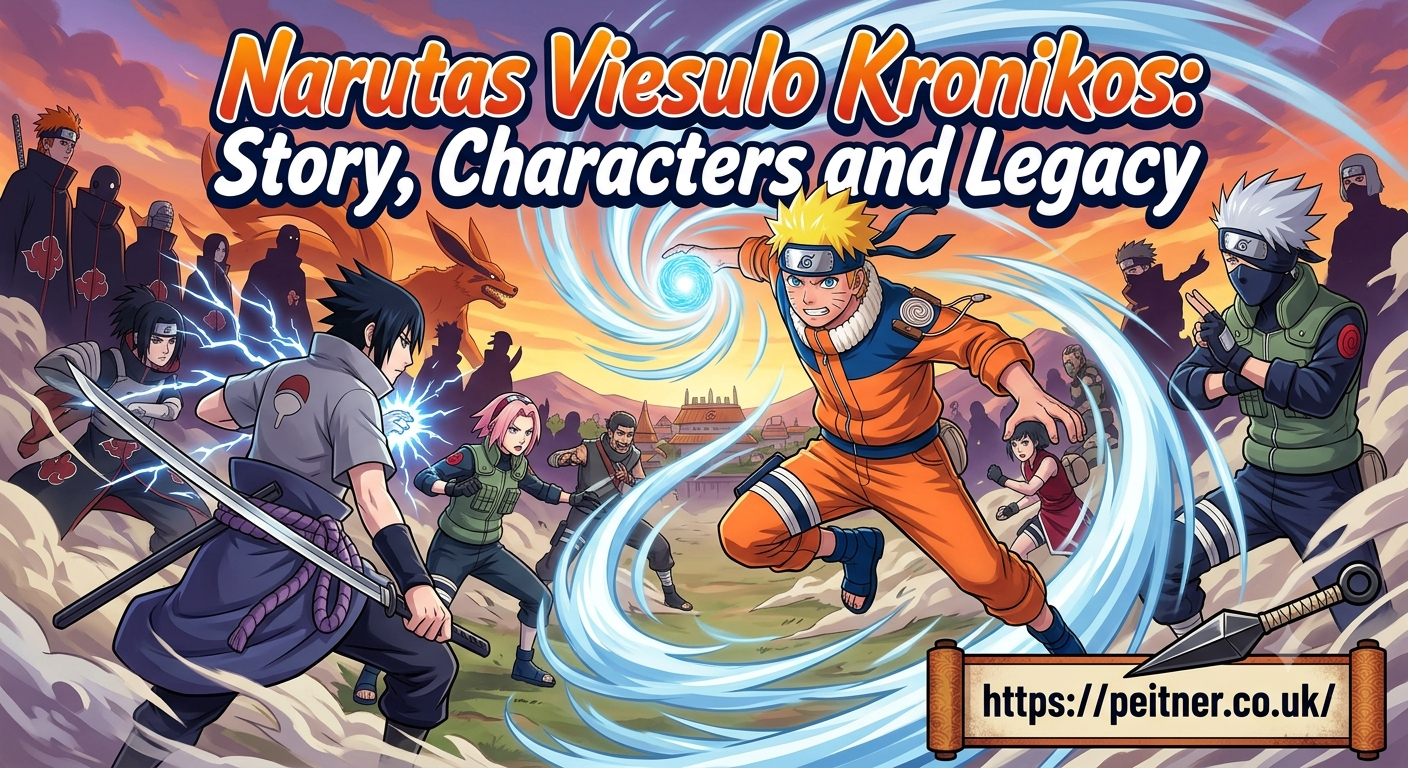
Narutas Viesulo Kronikos: Story, Characters and Legacy
Table of Contents
- What Is Narutas Viesulo Kronikos?
- How the Series Continues Naruto
- The Main Story Without Major Spoilers
- Naruto Uzumaki’s Growth
- Sasuke Uchiha and the Cost of Revenge
- Why the Akatsuki Changed the Story
- The Most Important Story Arcs
- Friendship, Pain and the Cycle of Hatred
- The Meaning of the Lithuanian Title
- Animation and Battle Storytelling
- Important Facts About the Series
- Why New Viewers Still Discover It
- Conclusion
Introduction
Narutas Viesulo Kronikos is the Lithuanian title commonly used for Naruto: Shippuden, the second major anime series in the Naruto story. It follows Naruto Uzumaki after a long training journey, when he returns to the Hidden Leaf Village older, stronger and ready to face threats far greater than those of his childhood.
The series offers spectacular ninja battles, but its real power comes from its emotional questions. Can people shaped by loss avoid creating more victims? Can friendship survive betrayal? And can a broken political system be changed without replacing one form of violence with another?
These questions give the anime a depth that goes far beyond its action scenes. The story gradually transforms from a personal mission to rescue a friend into a much larger examination of war, leadership, justice and inherited hatred.
What Is Narutas Viesulo Kronikos?
The phrase Narutas Viesulo Kronikos refers to the Lithuanian localization of Naruto: Shippuden. Lithuanian media records identify it as the local title of the Japanese anime and report that a Lithuanian voice-over aired on BTV around 2013. The original Naruto series had previously appeared on the Lithuanian channels LNK and TV1.
The Japanese word “Shippuden” carries the idea of a powerful or rapidly moving wind. “Viesulo kronikos,” which can be understood as “chronicles of the whirlwind,” therefore feels appropriate.
Naruto returns home just as hidden conflicts begin turning into a storm that will affect the entire ninja world. The translated title captures this movement surprisingly well. It suggests that viewers are not watching one simple adventure, but a long record of battles, losses and major historical changes.
How the Series Continues Naruto
The story begins about two and a half years after Naruto and Sasuke’s confrontation at the Valley of the End. Naruto has trained with Jiraiya, Sakura has become a capable medical ninja, and many of their former classmates have also matured.
Naruto returns to Konoha hoping to reunite with his friends and continue his search for Sasuke. However, there is little time for a peaceful homecoming. Gaara, now the Kazekage of the Hidden Sand Village, is kidnapped by the Akatsuki as part of its plan to capture the tailed beasts.
Studio Pierrot records the original Japanese broadcast of Naruto: Shippuden from February 2007 to March 2017 and lists a total of 500 episodes.
The time jump changes the tone of the story. These characters are no longer academy students dealing with training exercises and simple missions. Their decisions now involve death, village politics, military power and consequences that cannot always be reversed.
The Main Story Without Major Spoilers
Naruto returns with three connected goals. He wants to become Hokage, bring Sasuke Uchiha back to the village and protect the bonds he formed during the original series.
At the same time, the Akatsuki organization is hunting the tailed beasts sealed inside human hosts called jinchuriki. Because Naruto carries the Nine-Tailed Fox, the organization’s plan places him directly at the center of the conflict.
The plot begins with rescue missions, investigations and efforts to gather information about Sasuke. It then expands into clan secrets, political manipulation and international warfare. Personal pain becomes a national problem, eventually leading to the Fourth Great Ninja War.
Even as the scale grows, the central question remains personal: can Naruto stop hatred without becoming consumed by it?
This focus prevents the series from becoming nothing more than a collection of increasingly powerful fights. Every major conflict is connected to a person’s past, an old betrayal or a political decision that created new suffering.
Naruto Uzumaki’s Growth From Outcast to Leader
Naruto Uzumaki begins the wider story as a lonely child who causes trouble because negative attention feels better than being ignored. In Narutas Viesulo Kronikos, he remains energetic and impulsive, but his desire for recognition gradually becomes a sense of responsibility.
His greatest strength is not simply his enormous amount of chakra. It is his ability to recognize loneliness in other people.
Naruto knows what it means to be feared and treated as a problem. Because of that experience, he can understand enemies whom other shinobi see only as monsters. He notices the rejected child or wounded person behind the dangerous techniques.
This does not mean Naruto forgives every crime without consequences. Instead, he tries to understand how a person reached that point. That distinction is important. Understanding the cause of violence is not the same as approving of violence.
His faith in people carries weight because it does not come from an easy life. Naruto repeatedly faces rejection, grief and anger. He simply refuses to let those experiences control every future decision.
By the later stages of the story, leadership means more to him than receiving the Hokage title. It means carrying other people’s hopes without treating them as tools.
Sasuke Uchiha and the Cost of Revenge
Sasuke Uchiha follows a darker path. Naruto responds to loneliness by building bonds, while Sasuke responds to trauma by cutting bonds away. He believes emotional attachment will weaken his pursuit of revenge.
Sasuke is not written as a simple villain. New information constantly changes his understanding of his brother, his clan and the Hidden Leaf Village. Each truth gives him another reason to question the official version of history.
That uncertainty makes his journey both compelling and frustrating. Just when Sasuke appears to have found a clear purpose, another revelation changes the direction of his anger.
The rivalry between Naruto and Sasuke eventually becomes a conflict between two ideas of peace. Naruto believes pain can be transformed through understanding and connection. Sasuke increasingly believes peace must be imposed through power, fear or control.
Their struggle is therefore not only personal. It asks what kind of future can survive after generations of violence.
Naruto sees saving Sasuke as proof that people do not have to be abandoned when they become difficult or damaged. Sasuke sees cutting his bonds as the only way to remain strong enough to reshape the world.
Why the Akatsuki Changed the Story
The Akatsuki gives Naruto: Shippuden much of its tension and visual identity. Its members share the famous black cloaks decorated with red clouds, yet they have very different personalities, fighting abilities and motives.
Some seek money or artistic immortality. Others are driven by loyalty, revenge or political ideology. Several believe lasting peace can exist only when the world experiences overwhelming fear and pain.
This variety keeps the group from feeling like a collection of identical villains. Every major Akatsuki member represents a different response to suffering.
The organization’s actions also expose the failures of the recognized ninja villages. The same political system that condemns the Akatsuki has produced child soldiers, secret experiments, clan persecution and repeated wars.
The villains remain responsible for their choices, but the story makes it clear that they did not appear in a moral vacuum. Many of them were created by the same violent system they later tried to destroy or control.
That fresh angle makes the Akatsuki more interesting than a traditional evil organization. Its members are enemies, but they are also evidence of how badly the shinobi world has failed.
The Most Important Story Arcs
Several storylines define Narutas Viesulo Kronikos, although fans may disagree about which one is the strongest.
Kazekage Rescue Arc
The Kazekage Rescue arc immediately shows how much the characters have grown. It also develops Gaara from Naruto’s former enemy into a leader who has earned the trust of his village.
Gaara’s kidnapping gives the returning Team 7 its first major mission. It also shows Naruto what his own life might have looked like if he had chosen isolation instead of friendship.
Sasuke and Tenchi Bridge Storylines
The Tenchi Bridge and later Sasuke-focused arcs bring Naruto closer to his missing friend while revealing how far Sasuke has moved away from Team 7.
Their reunion is powerful because it offers no easy emotional repair. Shared childhood memories are no longer enough to erase the choices Sasuke has made.
Hidan and Kakuzu Arc
The Hidan and Kakuzu storyline gives Shikamaru one of his strongest roles. It treats grief as something that changes a person’s thinking rather than as a brief excuse for another fight.
Shikamaru must balance emotion with strategy. His response shows that intelligence is not the absence of feeling. In some situations, careful planning becomes the way a person survives overwhelming emotion.
Pain Arc
The Pain arc is widely remembered because it combines destruction with a serious argument about revenge.
Naruto must answer an enemy whose suffering is genuine even though his solution is cruel. The conflict forces Naruto to move beyond simply promising that he will never give up. He must explain what he plans to do with his anger.
Five Kage Summit and Fourth Great Ninja War
The Five Kage Summit and Fourth Great Ninja War expand the conflict across multiple nations. These sections contain major revelations, returning characters and enormous battles.
However, their strongest moments still focus on memory, identity and inherited hatred. The war is not only about defeating a powerful enemy. It is about whether villages with long histories of betrayal can finally cooperate.
Friendship, Pain and the Cycle of Hatred
The strongest theme in the series is the cycle of hatred. One person suffers, seeks revenge and creates another victim. That victim may later repeat the same process.
Families, clans and entire nations build their identities around wounds they refuse to release. Each side remembers what was done to it while ignoring the suffering it caused others.
Naruto learns that understanding an enemy does not mean approving of that enemy’s actions. It means recognizing the source of violence before deciding how to stop it.
The story also presents friendship as a demanding responsibility rather than a comfortable feeling. Naruto’s refusal to abandon Sasuke can appear unreasonable, but it represents his refusal to treat damaged people as disposable.
Sakura, Kakashi, Shikamaru and Gaara face similar choices. They must decide which values should survive when loyalty becomes painful.
This is one reason the story connects with viewers beyond its fantasy setting. Most people will never fight in a ninja war, but many understand rejection, grief, guilt and the difficulty of forgiving someone who has caused real harm.
The Meaning of the Lithuanian Title
The title Narutas: Viesulo kronikos changes the feeling of the series for Lithuanian audiences.
“Chronicles” suggests a long record of connected events. “Whirlwind” suggests force, speed and instability.
Together, the words describe the structure well. Naruto stands at the center of a storm created before he was born. Clan conflicts, village politics, tailed beasts and secret plans spin around him.
He cannot escape by pretending these problems do not exist. He must enter the storm, understand its history and find a path through it.
Localized titles also become part of cultural memory. Viewers who first encountered the anime on Lithuanian television may find Narutas Viesulo Kronikos more familiar than the international title Naruto: Shippuden.
Both names identify the same series, but each carries a slightly different emotional connection. One belongs to the worldwide anime franchise. The other may remind Lithuanian viewers of the particular channel, language and stage of life through which they discovered Naruto.
Animation and Battle Storytelling
Because the anime ran for a decade, its visual quality varies. Some episodes rely on limited movement, while major fights receive more expressive animation and ambitious choreography.
The strongest battles reveal character. Careful fighters plan several moves ahead, emotional fighters accept dangerous risks, and deceptive fighters manipulate what their opponents believe.
A confrontation often begins as a contest of techniques and ends by revealing a hidden fear, memory or motive.
The fighting system also rewards strategy. Raw power matters, but knowledge, timing, teamwork and control over information can completely change a battle.
Music strengthens the experience by giving grief quiet space and making major arrivals feel larger. The opening and ending songs also became markers of different periods in the story for many fans.
Important Facts About Narutas Viesulo Kronikos
- International title: Naruto: Shippuden
- Lithuanian title: Narutas: Viesulo kronikos
- Original manga creator: Masashi Kishimoto
- Animation studio: Studio Pierrot
- Original Japanese broadcast: February 2007 to March 2017
- Total number of episodes: 500
- Story position: Continuation of the original Naruto anime
- Opening time jump: Approximately two and a half years
- Main characters: Naruto, Sasuke, Sakura, Kakashi and Gaara
- Major antagonistic group: The Akatsuki
- Central themes: Friendship, revenge, leadership, war and the cycle of hatred
The production dates and episode total are confirmed by Studio Pierrot, while the Lithuanian title and reported BTV voice-over are documented by Lithuanian media-focused records.
Why New Viewers Still Discover It
Modern anime often arrives in short seasonal runs, while Narutas Viesulo Kronikos offers a much longer journey. The length can feel intimidating, but it gives viewers time to become attached to secondary characters, villages and rivalries.
The series works especially well for people who enjoy emotional action stories. Its world contains supernatural techniques and enormous battles, but its conflicts grow from familiar feelings: wanting approval, fearing abandonment, grieving someone or wondering whether revenge will bring relief.
A 500-episode television production naturally contains repeated flashbacks, slower sections and anime-original material. Viewers who want to follow the central manga storyline can use a spoiler-free episode guide. Others may enjoy the additional stories because they offer more time with supporting characters.
The real reward is accumulation.
A promise made early in the story can return hundreds of episodes later with greater meaning. Relationships change slowly, while victories feel earned because the audience remembers the failures that came first.
The series also provides several ways to experience its world. Some viewers are drawn to Naruto’s determination, while others prefer Sasuke’s darker journey, Shikamaru’s intelligence, Gaara’s transformation or Kakashi’s quiet sense of responsibility.
This range allows different characters to become important at different stages of a viewer’s life.
Conclusion
Narutas Viesulo Kronikos is more than a Lithuanian name for Naruto: Shippuden. It is an appropriate title for a story about a young ninja entering a storm of inherited conflict and refusing to let that storm decide who he will become.
Naruto’s dream of becoming Hokage gives the plot direction, but his deeper achievement is turning loneliness into empathy. Sasuke shows how pain can become isolation. The Akatsuki reveals the failures beneath the shinobi world’s heroic image, while the Fourth Great Ninja War tests whether old enemies can build something together.
Not every episode moves at the same pace, and not every storyline reaches the same emotional level. Still, the series creates a rare sense of history. Battles, friendships and losses feel connected to a journey that unfolds over many years.
For Lithuanian fans, Narutas: Viesulo kronikos also recalls the local television experience through which many viewers first entered the Hidden Leaf Village.
The title describes a whirlwind, but the heart of the story remains steady: people may be shaped by pain, yet they do not have to pass that pain on to someone else.
